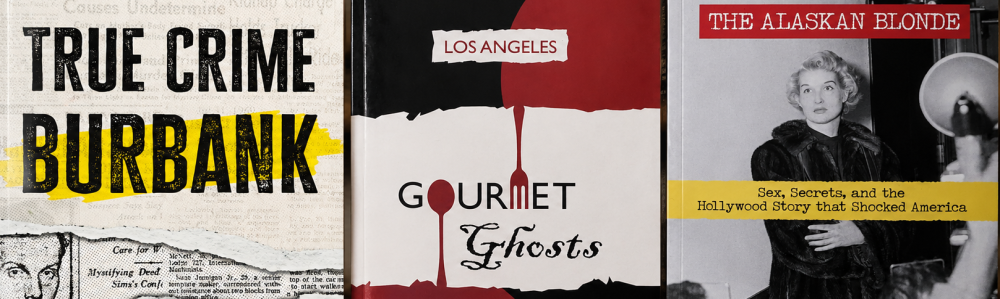
As you might imagine, I spent many, many hours at the Burbank Central Library on the microfiche reader – a classic old school piece of research equipment. It went out of order a week or two after I had finished however, but apparently the Friends of the Burbank Library are paying for the Valley Times and other long-gone Burbank newspapers to be digitized. That will be a long process, however. And of course the LAPL’s archives of LA Times and photos on TESSA – I am on there almost every day.
Am thrilled I can repay the library a little by giving a talk on October 20, though it will be at the Buena Vista branch, which has a larger function room (one of the reasons this Central Library is being replaced in the next year or two by a huge new facility, just across the road. I wonder if they’ll move the statue of Dr Burbank there too?)
My research was fueled by beef and potato-filled piroshkis, which I bought for lunch at the Classic Pastry store nearby. And the occasional custard-filled treat! Also, I listed to music a lot, especially a synthwave set by DJ LoFi Girl There was one particular track that I loved: Downtown Binary by Atlantis.
TESSA is the name for the digital photograph collection of the Los Angeles Public Library, and among the many thousands of images are those of the Valley Times, a newspaper that was in print from 1946 to 1970.
One particularly chilling photograph of theirs shows Burbank detective Robert Coveney holding what appears to be some large pieces of rock – only there were suspicions that they were in fact the remains of a burned human heart, lung and bones.
The heart, which had threads of what appeared to be silk attached – perhaps from the clothes its owner had been wearing? – had been found by Lionel Meeker on October 13, 1948 when he was cleaning the incinerator at the rear of his new home, a small white cottage on North Catalina Avenue.
The grim and puzzling discovery was described as “plunging police into a full-scale investigation of a possible mystery murder,” and the items were rushed to the sheriff’s crime laboratory in Los Angeles for analysis.
What had happened? Had someone been killed and their remains burned in an attempt to hide the crime? Police established that a Robert Lincoln Scott had lived there from 1933-1938, but he was since deceased, and before Meeker, two young men had lived there together.
It wasn’t unknown for medical students to play pranks with amputated legs or hands they had purloined from their classes and studies, but this was different. When further “bones” were found in the ashes Meeker, 22, told police he had washed away into the street at the end of a nearby avenue, investigators became more concerned.
Detective Coveney felt there was “no doubt” they were human, but then the laboratory results came through, and Lieutenant Fred V. Wolfe reported that preliminary analysis showed them to be inorganic matter, perhaps plaster of Paris or asphalt.
The story disappeared from newspapers immediately, and perhaps these “human remains” were just old props from a movie designer or make-up specialist, or were thrown into the flames by a frustrated artist.
There are maybe one or two Friday 13ths every calendar year – sometimes there are none – but on this Friday 13th September 2024, I thought I would list some of my favorite (and most mysterious) mysteries from Gourmet Ghosts. What do you think happened?
The “Ghost Woman Sought” headline is from November 1922, when rancher Vaden Elwynne Boge was poisoned at the Alexandria Hotel. Police searched for his wife, who was suspected of the crime, but never found her…..
The man in the collar and tie is Ludwig Steiner, a clerk and resident at the Barclay Hotel in 1915 – until he disappeared suddenly among rumors that he was German spy. Steiner spoke seven languages, and among the possessions he left behind was a picture of him in the uniform of the Austrian army. He said he had been arrested while in Japan and charged with espionage too… but was all that true?
A severed leg? One was found in 1895, wrapped in pages from a newspaper, at the downtown LA address that’s now the STILE Hotel (and was built as the United Artists Theater in 1927). The United Theater still operates there as an events venue – and it is said to be haunted (but by any one-legged ghosts?).
Also below is a picture Chinese-Canadian tourist Elisa Lam, and the Cecil Hotel. If you don’t know about her bizarre 2013 death here in the water tank – then just Google it!
That sad picture of that kid praying to Santa (?) is from December 1925, and poor “Buzz” Reeve, 3, wants his dad, Raymond, who had gone from LA to meet a business contact at the Hoover Dam, near Las Vegas, to discuss a lucrative contact – and had not been seen since. It had emerged that this meeting seemed to be a scam – or a trap….
Finally, that’s a picture of Elizabeth Short from the Historic Corridor at the Biltmore Hotel, the last place she was officially seen alive in 1947. A few days later, she was found brutally murdered – and is known to his history now as “The Black Dahlia.”
You can read more about all of them, of course, in the Gourmet Ghosts books….
When it was built in 1936 it was touted at the first outdoor shopping mall in America, and was given an international theme – hence the impressive name. That theme was literally built in, as you can tell from the Streamline Moderne ocean liner that looks like it has just docked among a number of foreign-styled bungalows.
The seven bungalows represented Spanish, Italian, French, Moorish and European architecture (as well as colonial New England and early California for American visitors), and they were planned as café’s and unique stores on the street level, and offices above (one of which was leased by Alfred Hitchcock).
There are other maritime elements here too – portholes, catwalk, a statue of a large pelican, a “lighthouse” at the back – and of course the huge Art Deco tower, which soars 30 foot above Sunset Boulevard and has a spinning white and blue globe on top with a bright red neon sign.
A landmark in Hollywood from day one, it was designed by Robert V. Derrah at a cost of $250,000, and his love of the sea is evident in another of his L.A. buildings, the Coca-Cola Building in South Central, a bottling plant that he built before the Crossroads and also looks like an ocean liner sailing the streets.
The mastermind behind the Crossroads development was Ella Crawford, who clearly had a love of – and connections with – the world of movies and the theatrical. On opening day, October 29, 1936, the LA Times reported there were foreign musicians, groups of native dancers and folk singers, while stars including Cesar Romero and Boris Karloff greeted guests at their native bungalows.
The opening night was as glittering as a movie premiere, though it’s hard to believe that many of the guests there didn’t know this building was born out of murder – and that Crawford’s determination to build the Crossroads was because her husband had been killed here.
That was the LA Examiner’s headline in on August 11, 1931, when Angelenos followed the story of a double murder at this address. Former deputy D.A. David H. Clark had been accused of killing Ella’s husband, Charles H. Crawford, a crooked gangster and politician known as “The Wolf of Spring Street,” and another man named Herbert Spencer, at Crawford’s real estate office here.
A witness said he had seen Clark leaving soon after hearing several gun shots – and it emerged Clark had bought a .38 Colt revolver the day before (the same bullets as found in the victims).
But Clark claimed the two men had pulled a gun on him, telling him to back off on his threats against the underworld, and wanting him to help them frame the Police Chief.
It sounds like the perfect noir story, and it certainly had all the ingredients: the handsome D.A., the crooked guys, a gun, dead bodies and a question: was it murder or self-defense?
Clark was tried twice – a mistrial and then acquitted – but just months after the Crossroads had been opened by widow Ella Crawford, he went missing but was found in France, apparently “insane.”
He didn’t escape criminal punishment forever though; he was later was convicted of murder at a drunken party, and died soon after starting his sentence in Chino Prison in 1954.
Crossroads of World was a memorial of a sort for Charles Spencer, and it seemed like a glamorous, winning concept. You could buy cigars, or handkerchiefs, or Asian art, or French dresses, or get a haircut in the latest style, and though celebrities and the public loved it for a while it didn’t last very long, and soon became more offices than stores.
It did get Historic-Cultural Monument status in 1974, but by then it was dilapidated and due to be demolished for – of course – a skyscraper, but developer Morton La Kretz bought and restored it, adding fountains and some other touches to the old style.
It was a music business favorite from the 1970s onward too: Jackson Browne, Bonnie Raitt and Crosby, Stills & Nash recorded and rehearsed here, as well Fleetwood Mac, Gladys Knight, Patti LaBelle, BB King, and America, who put the Crossroads Tower (surrounded by grass and palm trees) on the back cover of their album America’s Greatest Hits.
Over the years it was of course featured in television shows and movies like Indecent Proposal, LA Confidential, “Dragnet” and “Remington Steele,” and in plenty of commercials and pop videos. Also, if you’re ever in Florida at Disney World, you’ll see a reproduction of the tower and globe inside the entrance to Disney’s Hollywood Studios.
Today it’s home to music companies, writers, production companies, and many more movie-related businesses – though there’s no restaurant or bar for them to hang out at, so it doesn’t fully qualify for Gourmet Ghosts 2.
Even so, it’s often easy to wander the “streets” of this unique and rather weird piece of L.A. history….