Avery Truesdale, aged just 19, died by suicide at Los Angeles City Hall on July 15. He jumped from the 26th floor observation deck, which is open to the public, though you have to show ID at security before entering the building.
LAFD medical personnel found him unconscious and not breathing on the steps of the building, and the autopsy listed the COD as blunt trauma. Tributes came in for the young man, who graduated Arcadia High School last year and was known for his talent on their baseball team.
This was seemingly only the third suicide at City Hall since it was built in 1928.
The first was on April 30, 1931, when Robert Pollock Craigie, 36, crawled out of a window on the 19th floor and jumped. He was a visitor to LA from Cairo, Egypt, where he worked at an oil company, and had planned to marry his local sweetheart, Hilda Seagroatt, but the stock market crash had bankrupted him.
“Death came quickly” reported the LA Times, which explained that Craigie had left two formal notes inside his cap on the floor behind him. Hilda was said to be baffled by his actions:
“Why, only a half-hour before he did it, we talked over the telephone and he seemed in the best of spirits. We made an engagement for dinner, and afterwards planned to move my belongings to a new apartment not far from his.”
The second suicide was in December 1934, when Michael Roomanoff, 43, leapt to his death here. There were few other details available, except that it was perhaps a “suicide-of-honor”, as his insurance policy went some – but not all – the way to paying back a large loan from his friend, Ben Stoloff.
A dive into the LA Times archives offered more information however, and a very interesting backstory for Roomanoff emerged. He was known as Gisch Roomanoff back in April 1931, when he was facing a $4,000 grand theft charge after swindling Meyer Levin, a Glendale builder, on an investment “opportunity” – and it appeared Levin was just the first of many victims.
“Financial advisor” Roomanoff had been transported to jail after spending time in the hospital at Redondo Beach, where he had jumped from the pier a week earlier – perhaps also a suicide attempt.
If you or someone you know is experiencing a mental health crisis, help is available 24 hours a day, seven days a week. Call or text 988 to reach the Suicide & Crisis Lifeline. Live support is also available online through its website.
Today I am posting the first in a new series of historical stories about murder, suicide and mayhem – and they will all be based around the Los Angeles River.
Many of you only know it as a concrete channel that has played backdrop to movies and TV, or shows up on the news when people or dogs need to be rescued from raging rain waters.
But the LA River, and the bridges that span it, has a long history. It was a vital resource for the indigenous people onward, and temporary bridges were the order of the day. They were often swept away when the river flooded, and even when the sun was out it was common for adults and children to end up in the murky waters, either by accident, murder or suicide.
So, I have researched some of the wildest, strangest and saddest stories associated with the LA River, which means for a start that the beautiful but infamous Colorado Street Bridge – the so-called “suicide bridge” in Pasadena – is here.
It opened in December 1913, and close to 100 people had their last earthly moments here in the more than two decades before the more notorious suicide hotspot, the Golden Gate Bridge in San Francisco, even opened: it’s arguably the equivalent of the Cecil Hotel in downtown LA, which is another location where many souls have passed to another realm….
On May 4, 1929, Leland Wesley Abbott, 33, was arrested in connection with the murder of a young woman whose torso had been found on April 4 in the quick sands of the LA River near Lynwood Gardens. She was missing her arms, legs and head, and “was about to become a mother,” noted the Los Angeles Times.
The torso was found after heavy rains and not more than 24 hours old, but identification was still uncertain. Her age was estimated to be 18-25, and her appearance roughly matched descriptions of Abbott’s wife – who was 22. The coroner also noted that the limbs and the head had been severed with some surgical skill.
Newspaper reports said that Abbot’s estranged wife had last been seen the day before the torso was found, and that a couple of days earlier to that Abbott had confided in a work colleague, Ray Martin, that she was living with a man in Lynwood, and that he intended to “get even” with her. He had added that there was “plenty of quicksand” in the LA River near where she lived.
The Sheriff’s Homicide Squad knew Abbott had served time for gun smuggling, and had married in Cincinnati soon after his release, but they were uncertain of his wife’s first or maiden name, let alone her whereabouts.
More promisingly, Abbott was known for carrying a surgical knife with a 5-inch blade, but further clues – a green slipper (size six, left foot) and some blood-stained towels found on the riverbed – were discarded as having no bearing on the case.
Two other men of interest – a physician who had left LA with his 19-year-old girlfriend, but neither of them had been heard from since – and another physician who was seen near the murder site, and had previous arrests. Both leads led nowhere either, nor did viewings by people who had recently-missing relatives.
Abbott was found on May 4 at a mountain camp on a government reserve, some 33 miles north of Mt. Wilson, where he said he’d gone for a road-building job. He didn’t have his knife with him though – which he said he carried because his stepfather was a surgeon – though investigators found a handful of weapons in Abbott’s trunk, which he said he had recently washed with gasoline. The trunk had some strange stains on it, too.
Then there was the anonymous call from a woman who had seen two men lift a large package out of a car alongside the LA River– and that there was a woman in the driving seat. She thought it was unusual, because at the time it was raining heavily. But she never called back.
Ultimately police simply didn’t have enough evidence to hold Abbott, and released him after a few days. Bizarrely, on May 12 Abbott returned to the police station with his knife, which he said he’d found. Presumably it passed forensic tests, because Abbott then returned to his road-building job, and the story disappeared from the newspaper archives….
October 23, 1983 – The LA Times reported on a crime that saw Police “baffled,” and had taken place the month before on Mexican Independence Day – still a big event on Olvera Street.
Glendale resident Elisabeth Sawicki, 53, was dressed in an outfit of “royal blue with large, bright and red and green floral patterns,” said LAPD Detective Joe Hargis. She had been celebrating the famous defeat of the Spanish at the El Paseo Inn, where she was a regular and known to all.
However, when she was returning to her car parked in Chinatown at around 8pm, she was shot and killed. Robbery wasn’t the motive – her purse wasn’t taken – and despite there being many people in the crowded streets no one had come forward.
Sawicki was said to have “no apparent enemies,” and so the lack of witnesses made this apparently motiveless murder even more confusing – and the killing was never solved.
The Cecil Hotel in downtown LA is infamous for murders and suicides – plus the “Night Stalker” stayed here, and tourist Elisa Lam was found dead in the roof water tank. I wrote about the Cecil Hotel recently celebrating its 100th birthday, and how one man is trying to make a difference…. https://www.sfgate.com/la/article/cecil-hotel-la-priest-20059489.php
It was great fun meeting SpookyFoodie at her Spooky’s Restaurant Club – the place was packed with lovely people who liked LA history, ghosts and crime: my type of people! Here are some pics…
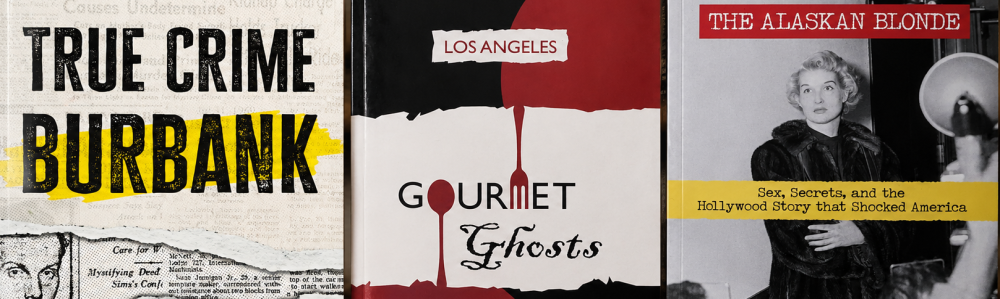
There are maybe one or two Friday 13ths every calendar year – sometimes there are none – but on this Friday 13th September 2024, I thought I would list some of my favorite (and most mysterious) mysteries from Gourmet Ghosts. What do you think happened?
The “Ghost Woman Sought” headline is from November 1922, when rancher Vaden Elwynne Boge was poisoned at the Alexandria Hotel. Police searched for his wife, who was suspected of the crime, but never found her…..
The man in the collar and tie is Ludwig Steiner, a clerk and resident at the Barclay Hotel in 1915 – until he disappeared suddenly among rumors that he was German spy. Steiner spoke seven languages, and among the possessions he left behind was a picture of him in the uniform of the Austrian army. He said he had been arrested while in Japan and charged with espionage too… but was all that true?
A severed leg? One was found in 1895, wrapped in pages from a newspaper, at the downtown LA address that’s now the STILE Hotel (and was built as the United Artists Theater in 1927). The United Theater still operates there as an events venue – and it is said to be haunted (but by any one-legged ghosts?).
Also below is a picture Chinese-Canadian tourist Elisa Lam, and the Cecil Hotel. If you don’t know about her bizarre 2013 death here in the water tank – then just Google it!
That sad picture of that kid praying to Santa (?) is from December 1925, and poor “Buzz” Reeve, 3, wants his dad, Raymond, who had gone from LA to meet a business contact at the Hoover Dam, near Las Vegas, to discuss a lucrative contact – and had not been seen since. It had emerged that this meeting seemed to be a scam – or a trap….
Finally, that’s a picture of Elizabeth Short from the Historic Corridor at the Biltmore Hotel, the last place she was officially seen alive in 1947. A few days later, she was found brutally murdered – and is known to his history now as “The Black Dahlia.”
You can read more about all of them, of course, in the Gourmet Ghosts books….
In early January 2023, there was the sad news that an employee of a building on Broadway in downtown LA had been killed in a elevator accident there. During recent talks and Zooms, I’ve found that people are both fascinated and repelled by such (often grisly) accidents, probably because in many ways it’s the ultimate nightmare.
Rare as they are today, I did a search through the Los Angeles newspaper archives and found that a hundred years ago or so they were more common than we might imagine, especially in hotels and banks. There are a couple of reasons for this. Firstly, in the early days many people were not used to elevators, which is why there were so official operators.
Moreover, they were not automated, meaning that the doors – if they had them – didn’t open and close automatically when they reached a floor. Nor did they have sensors that would stop/re-open doors instantly when someone tried to get in or out.
Also, many elevators were powered simply by a stop/go lever, and the counterweights often weren’t distant or encased away from the carriage. Also, with sliding concertina metal gates it was easy to pull them back if you wanted to (stupidly) peer into the shaft. Many people also didn’t look before they stepped into the carriage – which wasn’t there yet (or had under or overshot the stop).
The lucky survivors of shaft falls often sued, which is probably part of the reason they became safer, but many didn’t survive, and these are some of the stories I found – including one building where three employees all died in separate incidents.
Van Nuys Hotel (103 W 4th St)March 4, 1897 – Waiter Charles G. Gamble and the elevator boy, Robert White, were going down to the first floor and “joking” together when White turned the lever the wrong way, and it began going up again.
Having “lost their presence of mind,” White jumped out of the still-moving elevator at the third floor and Gamble, apparently frightened, tried to follow him out – but too late. Caught in the doorway, the rising elevator then pinned his legs, which “snapped like pipestems…”
The Los Angeles Times went on to graphically describe how Gamble’s body was dragged up by the foot until “that was smashed” and he fell head-first to his death, his skull fractured in multiple places and his left eye actually torn from the socket.
Amazingly Gamble was still alive, but “after nearly an hour of intense suffering,” he died in hospital.
Van Nuys Broadway Hotel (4th & Broadway)January 3, 1900 – Tragically (and creepily) a second hotel named the Van Nuys Broadway and also owned by the same person as the Van Nuys).
Bell boy Earl Newton, aged just 16, was on top of the elevator cage when he accidentally pulled on the power rope, causing the elevator to rise and trap him between the shaft and the ceiling on that floor. His internal organs were instantly crushed, and the blood rushing to his head turned his face purple.
Van Nuys Hotel (again)September 21, 1901 – Joe Kato, a Japanese assistant janitor, couldn’t overcome his curiosity about the open elevator shaft, and peeked into the darkness.
Predictably – and horribly – he was hit on the head by the 4800 lb counter weight that went down as the elevator went up, and was killed instantly.
Hellman Building (411 S Main St, besides the Stowell Hotel/El Dorado Lofts)February 8, 190 – Head janitor Chris Larsen was hit by the descending cage of the elevator, and killed instantly. “Nearly the whole top of his head was torn off, and the unfortunate man’s brains and blood were spattered along the sides of the elevator shaft from the fifth floor to the basement.”
He had been standing on the top of another elevator cage, cleaning the ironwork on the inside of the shaft, and had leaned out several times – and been warned to be careful – but he laughed off any concerns: something that turned out to be a deadly decision.
Bradbury Building(304 S Broadway) November 22, 1908 – The head janitor was looking for his assistant, 34-year-old Carl King, but couldn’t find him anywhere – until he looked down the elevator shaft and saw his body, which had been there for several hours.
King’s skull had been crushed and many bones broken, and it emerged that he probably got caught between the 2nd and 3rd floors, and had been hurled about 35 feet to his death.
Alexandria Hotel(501 Spring St) December 22, 1910 – Two men were killed and two injured when the platform they were standing on in the elevator shaft, which also had barrels of plaster on it, collapsed.
Ernest Pearman and Joseph Lawrence, both plasterers, fell seven floors; Pearman’s skull was crushed and he died at the scene, but Pearman, also with a skull fracture and several ribs that had punctured his liver, lingered for several painful hours in hospital.
The other two men, Stephen Smith and Charles Lentz, managed to grab something and save themselves; they only suffered cuts and bruises.
Douglas Building, 257 S. Spring StDecember 20, 1905 – Clifford J Rudd, engineer of the building for past four years, entered the counterweight shaft and stood on a small platform he had constructed to adjust the tension of cables.
The elevator car was at the bottom of the shaft, and what happened next was unknown, but his body was found lying across an iron beam, crushed under that counterweight.
March 31, 1941 – 80 year old elevator operator WP Brown ran to get into the elevator but was too late, and fell three floors down the shaft to his death. Apparently he had been unwell…
February 18, 1948 – John Goris, a 50 year old carpenter, was decapitated when the elevator balance weight struck him on the back of the neck. Goris had been working on an elevator repair, and put his head through a hole in a wall – and was hit by the weight.
Related to that:May 6, 1945 – down in this basement at the E Clem Wilson Building at the corner of Wilshire/La Brea, when Bureau of Power & Light engineer Orin E. LaRue was working on one of the transformers when it accidentally exploded. He was electrocuted by 4800 volts, the shock setting him alight and – horrifically – ripping his head from his body.
Roosevelt Building (7th & Flower)January 7, 1927 – Laborer R. Ponce, 45, slipped into an empty elevator shaft and fell eight storeys to his death.
Spring Arts Tower (453 S Spring St)July 4, 1927 – Kevin Taylor, history graduate and former manager of the Spring Arts Tower, has done considerable research on the building, and he said that it has plenty of spooky stories:
“I first came here about seven years ago, and the third floor was like an abandoned old school. It must have been an adult vocational school because there were still desks there, old computers, chalkboards and even old gurneys – they must have taught nursing there too.”
It seems that the night watchman is still making his rounds on the 3rd floor; there have been reports of a ghostly figure going around opening and closing doors and the sound of a bunch of jingling keys.
Employees at the Citizens National Bank heard a man groaning around 10am the previous day, but could not find anyone in distress.
It emerged that sometime during the previous night watchman Al Brietenbecker had fallen from the 3rd floor down the freight elevator shaft to the sub-basement, severing a major artery in the fall. Evidence showed that he tried frantically to staunch the flow of blood with torn pieces of his own clothing, but his efforts were unsuccessful and his dead body was found around midday.
Los Angeles Courthouse November 25, 1927 – It appeared that “Congo”, a rat who had gotten fat off eating first the contents of a sack of peanuts that were evidence – and then from countless pieces of cheese left out in traps to try and catch him – had committed suicide by jumping down the elevator shaft.
Congo – who had also allegedly grown whiskers a foot long and had a huge, furry coat after apparently eating a Judge’s bottle of hair restorer, was best friends with Megan, a gray-haired stray cat that had become the Courthouse cat – and, instead of chasing down Congo as the employees hoped, had in fact become Congo’s best friend.
The pair were often seen together, both on the roof and inside elevators, and even sometimes climbing the sides, scaring passengers. But recently it appeared that Megan had been run over and killed on Temple Street, and it seemed that Congo could not live without his (or her) best friend….
Christie Hotel, Hollywood (now Scientology Building 6724 Hollywood Blvd)September 1, 1943 – Albert Bellerose, 28, an elevator operator who had only worked at the Christie for three days, was killed.
His head and neck were “crushed” when he was somehow dragged into the narrow space between the lift and the shaft. Witnesses said they heard a scream, and saw his legs extending from the top of the elevator door.
The fire department had to be called to “extricate his body.”
Spring Arcade(541 S Spring St)January 30, 1946 – Ernest C. Bean, 55, an employee for the Spring Arcade, tried to jump onto a sidewalk elevator in the basement, but mistimed his jump and was killed instantly when his body was crushed against an overhead beam.
Just back from my first trip to Brisbane, Australia – a fantastic city – and thought I would share the ghost signs I found. I also popped to Melbourne to play my first official game of trugo as a member of Yarraville Trugo Club, and snapped a couple there – included them as well. And a few from Fairbanks, Alaska, when I was there earlier this year – bonus!