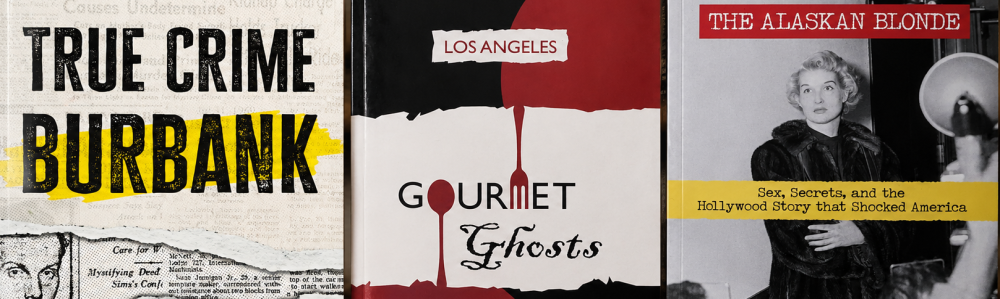
Category Archives: True Crime Burbank
Burbank Book Festival – 10/3/26
I was great fun at the recent Burbank Book Festival – see pics below. There was a line of people who bought the book and wanted to say hello, so much so that I didn’t get any good pictures to show besides these below. Despite the heat, it was all a huge success!


Zombie Resurrection at the Blue Room Bar?
August 18 is the official release day – or “Book Birthday” – for True Crime Burbank, and so you can imagine how thrilled I was to find a newspaper article from August 18, 1974 about the Blue Room Bar in Burbank, which appears in the book. This story doesn’t though, as I came across it after I had finished my research…

On that day, the LA Times reported that bartender Tommy Monette, 45, had been declared officially dead by the Veteran’s Administration – but the picture showed he was in fact behind the bar and pouring beers for the regulars who were jokingly celebrating his death!
A WWII veteran, Monette got disability checks from the VA, and they had suddenly stopped – the letter they sent shocked his wife, as you might imagine!
A farcical bureaucratic merry-go-round followed as Monette tried to prove who he was, but the VA stuck to their guns, even telling Monette it must have been an error the mailman made. Monette simply replied that he knew his mailman personally – he drank in the Blue Room – and he wouldn’t have made such a mistake.
Monette gritted his teeth through the whole thing, but happily the checks – and the beers – began flowing again.
The Burbank PD & Fire Museum
The current Burbank Police/Fire HQ has some excellent action-filled murals, and a small Museum. Inside you’ll find a vintage fire truck, police car and motorbike, memorials, uniforms, badges, wanted posters, photographs, confiscated weapons, fire hoses, gun belts, and a full-size McGruff the Crime Dog!
The murals are in the lobby, and one depicts Luther Colson, Robert Normand, Joseph R. Wilson and Richard E. Kunkle (1960s), and Matthew Pavelka (2003) in their historical uniforms and vehicles – officers who died in the line of duty. I cover the cases of the first two officers who fell in the line of duty in the book.


Some great Burbank signs and murals


Interview with the Burbank Leader

I was interviewed by the Burbank Leader newspaper – you can read it here.
May 1959 – “The Case of Incriminating Dominoes”

One of the strangest stories was how dominoes led to the arrest of someone for two murders. Here’s an excerpt from the book:
“The marriage between Phyllis and John Parks – just nine months of it – was on the rocks. It was May 28, 1959, and Phyllis, twenty-three, had returned to their trailer when another row began. Her friend Armand Garrison arrived soon after, but when Parks insisted that he and Phyllis were leaving, Armand allegedly snapped back, “Over my dead body, I’ll kill her first.” Parks insisted that Armand “suddenly went berserk” and stabbed Phyllis to death with a ten-inch bread knife, then came after him.
“There was a struggle, and Parks managed to break free and bolt out of the trailer. Armand followed but fell, and Parks managed to grab the knife and kill his pursuer.” The LAPD weren’t convinced by Parks’s self-defense plea and survival story, and he refused to take a lie detector test.
“Upon arrival at the [scene,] detectives noticed something very revealing. Parks had said that the trio [were] sitting playing an amicable game of dominoes when the argument began, but if that was the case and Armand had suddenly stabbed Phyllis and then struggled with Parks before stumbling outside, how come the dominoes were still in place on the small table? Some of them were even still upright. Parks was charged with the two murders.”
How I wrote “True Crime Burbank”
As you might imagine, I spent many, many hours at the Burbank Central Library on the microfiche reader – a classic old school piece of research equipment. It went out of order a week or two after I had finished however, but apparently the Friends of the Burbank Library are paying for the Valley Times and other long-gone Burbank newspapers to be digitized. That will be a long process, however. And of course the LAPL’s archives of LA Times and photos on TESSA – I am on there almost every day.
Am thrilled I can repay the library a little by giving a talk on October 20, though it will be at the Buena Vista branch, which has a larger function room (one of the reasons this Central Library is being replaced in the next year or two by a huge new facility, just across the road. I wonder if they’ll move the statue of Dr Burbank there too?)
My research was fueled by beef and potato-filled piroshkis, which I bought for lunch at the Classic Pastry store nearby. And the occasional custard-filled treat! Also, I listed to music a lot, especially a synthwave set by DJ LoFi Girl There was one particular track that I loved: Downtown Binary by Atlantis.


The location of the Burbank PD – then/now


The Burbank Police station was originally at the corner of East Olive Avenue and South 3rd St in Burbank. There’s a commemorative plaque about it at what’s now the Another Broken Egg Café. It still had a law enforcement connection though: many jurors serving next door in the local courts come for breakfast or lunch. The new Burbank Police and Fire HQ opened at 311 E. Orange Grove Ave in 1998 – right nearby. Inbetween them is the City Hall.
The current Burbank Police/Fire HQ has some excellent action-filled murals, and a small Museum: Inside you’ll find a vintage fire truck, police car and motorbike, memorials, uniforms, badges, wanted posters, photographs, confiscated weapons, fire hoses, gun belts – and a full-size McGruff the Crime Dog! The murals are in the lobby, and one depicts Luther Colson, Robert Normand, Joseph R. Wilson and Richard E. Kunkle (1960s), and Matthew Pavelka (2003) in their historical uniforms and vehicles – officers who died in the line of duty. I cover the cases of the first two in the book.
A horrific story that DIDN’T make the book “True Crime Burbank”

TESSA is the name for the digital photograph collection of the Los Angeles Public Library, and among the many thousands of images are those of the Valley Times, a newspaper that was in print from 1946 to 1970.
One particularly chilling photograph of theirs shows Burbank detective Robert Coveney holding what appears to be some large pieces of rock – only there were suspicions that they were in fact the remains of a burned human heart, lung and bones.
The heart, which had threads of what appeared to be silk attached – perhaps from the clothes its owner had been wearing? – had been found by Lionel Meeker on October 13, 1948 when he was cleaning the incinerator at the rear of his new home, a small white cottage on North Catalina Avenue.
The grim and puzzling discovery was described as “plunging police into a full-scale investigation of a possible mystery murder,” and the items were rushed to the sheriff’s crime laboratory in Los Angeles for analysis.
What had happened? Had someone been killed and their remains burned in an attempt to hide the crime? Police established that a Robert Lincoln Scott had lived there from 1933-1938, but he was since deceased, and before Meeker, two young men had lived there together.
It wasn’t unknown for medical students to play pranks with amputated legs or hands they had purloined from their classes and studies, but this was different. When further “bones” were found in the ashes Meeker, 22, told police he had washed away into the street at the end of a nearby avenue, investigators became more concerned.
Detective Coveney felt there was “no doubt” they were human, but then the laboratory results came through, and Lieutenant Fred V. Wolfe reported that preliminary analysis showed them to be inorganic matter, perhaps plaster of Paris or asphalt.
The story disappeared from newspapers immediately, and perhaps these “human remains” were just old props from a movie designer or make-up specialist, or were thrown into the flames by a frustrated artist.