Extra! Extra! The Ghosts of Inceville (Gladstone’s in Malibu)

Located on some of the most glamorous real estate around – right on the beach in Malibu – this restaurant is right where Sunset Boulevard meets the Pacific Coast Highway, though 100 years ago neither of those roads existed, and this was the center of Inceville.

Created and built by silent movie producer/director Thomas Ince, this purpose-built studio “city” eventually covered nearly 20,000 acres and started at the water’s edge before going up Santa Ynez Canyon and into the mountains. The streets were lined with houses of every type, and in every direction there were stages mocked up to look like countries from around the world. All of them were ready-to-go, and there were carpenters to build them if they weren’t.

The studio itself was where Gladstones is today, and back then there were also dressing rooms, offices, a canteen, roaming cattle and even a Wild West touring show that set up home here too. Inceville had everything a movie needed, and though actors came in from L.A. by trolley bus (can you imagine that today?) Ince himself lived in a house overlooking his empire. In 1913 alone over 150 two-reeler movies were shot here, and many of them were – unusually historically accurate – Westerns, which earned him the name “the Father of the Western”.

It was also at Inceville that the “shooting script” – a script that had directions for all the crew as well as the dialogue – was first developed, and by 1915 this was a complex production line similar to studios of today. Ince supervised more movies than he actually directed, and was the first to realize that you needed separate producers, writers and production staff: no-one could do it all by themselves. Ince became a veritable movie mogul, and when movies become longer and more expensive he joined forces with D. W. Griffith and Mack Sennett and moved operations to a new studio in Culver City, using Inceville for exteriors and the ever-popular Westerns.

Sadly, Inceville didn’t last. On January 12, 1916 an explosive fire broke out in the negative cutting room (film stock in those days was highly flammable) and eight workers were burned on the face and hands. Ince was badly injured too, having had to run through flames to escape, and ended up with a sling and bandages on his head. Other employees suffered minor burns as they fled, and the “picturesque” scene (“Not Staged” insisted the newspaper headline) saw “real” firemen mixing with actors and actresses in costume.

In 1918 Ince set up “Thomas H Ince Studios” on land at the Culver City studio, but his glory days seemed to be behind him and by now Inceville was “the Pompeii of ghost towns” – abandoned studios and sets dotted California in those days – and a Los Angeles Times article of May 29, 1921 reported as Ince visited for the first time since he’d left.

An Aztec Temple, stage coaches, a lighthouse, statues, and a church were rusting and rotting away, though the dressing rooms, stages and a whole Mission Town were still suitable for production. Despite further fires over the years the studio did carry on under various new names, and Ince noted:

“There was never a studio like it. I’ll never forget the days I spent here. We really lived then.”

Around the time he left for Culver City, there was a deadly accident at Inceville. The Los Angeles Times of November 22, 1918 reported that a set scaffold had collapsed, sending nine carpenters plummeting 40 feet down to the ground. Two men – Alvin Riggs and William H. Graham – died instantly of broken necks, with C.F. Kittredge dying the next day. The others were in hospital, two of them seriously injured.

Also, on April 15, 1929 it was reported that 16 year old Goldie Bigman had been killed when the vehicle she and several others were riding in went off the road at Castle Rock curve and plunged 15 feet into the water below. The group had been attending a “weenie bake” (cook out) on the Inceville beach – the one in front of where Gladstones is now – and were on their way home in the early hours of the morning. Several of the passengers were also injured.

Several years before on November 19, 1924, Ince’s own story came to an end during celebrations for his 42nd birthday, and his death was one of the most mysterious stories in Hollywood history.

He was on newspaper magnate William Randolph Hearst’s yacht Oneida with guests including Charlie Chaplin, Marion Davies and newspaper columnist Louella Parsons when he fell ill and, though he had been in poor health and suffered further heart attacks and died later at home, rumors swirled back on land about what had “really” happened.

It was alleged that Hearst accidentally shot Ince in the aftermath of a confrontation with Chaplin, whom he suspected of having an affair with Davies, his actress girlfriend. The rumors sparked a short-lived official enquiry, and many wondered why Hearst gave Ince’s widow a trust find and allegedly paid off their mortgage. In 2001 a movie called The Cat’s Meow recreated that night, with Ince being played by Cary Elwes.

A movie pioneer whose legacy is in Sony Pictures’ Culver City Studios, Ince has a star on the Walk of Fame in Hollywood and a street named after him beside the studio, yet he’s best remembered as the subject of a scandal – a rather sorry end to his story.

Gladstones is now owned by former Los Angeles Mayor Richard J. Riordan, and was more famous for its ocean view and the origami-like aluminum foil swans and rabbits you took your leftovers away in, rather than the actual food itself. The view is still the thing for now though, and huge windows and a massive deck of tables and chairs shaded under giant “Jumbrellas” (complete with heaters, speakers, lights and small TV screens) are now waiting for you – though with 700 seats it’s not necessarily the place for a quiet, romantic dinner.

As for the unusual “Gladstones 4 Fish” sign outside, it refers to the days when the telephone prefix for this area was 454. The first two numbers can equate to G and L on the dial, so the prefix could read GL4 – and of course, Gladstones was the place for fish!

Extra! Extra! James T.Bartlett on The Satin Lounge – at midnight! – with Kia Rene

Subscribe to continue reading

Subscribe to get access to the rest of this post and other subscriber-only content.

Extra! Extra! James T. Bartlett interviewed on KCRW 89.9 FM’s “Good Food”

Last weekend I was on KCRW’s “Good Food” program with Evan Kleiman talking about haunted places to got for Halloween, and you can hear the interview at about 23 minutes in…
http://www.kcrw.com/etc/programs/gf/gf121027haunted_restaurants_?utm_source=feedburner&utm_medium=feed&utm_campaign=Feed%3A+kcrw%2Fgf+%28Good+Food%29

Extra! Extra! Pictures from my events at Last Bookstore and Chevaliers

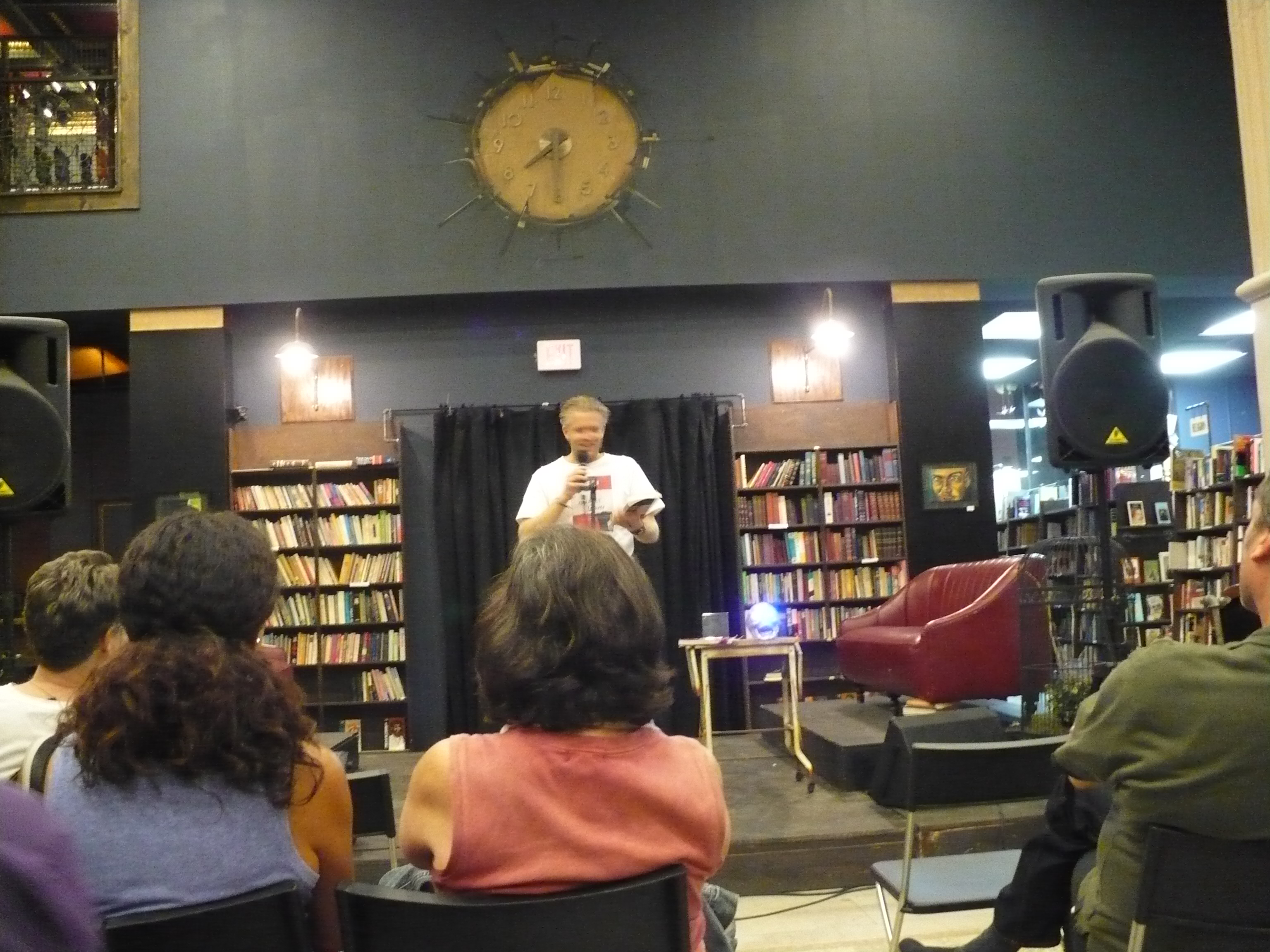
Behind my signing table at the big launch at the Last Bookstore in DTLA

Talking on stage! Everyone came on the mini-walking tour up 5th Street afterward…


A sunny afternoon in Larchmont!

Extra! Extra! Smoke House – Burbank

October 24, 2012

Another one that didn’t make the cut, but had a great gangster connection……

An established favorite in San Fernando Valley for over 60 years, the Smoke House is a stone’s throw from Hollywood and has hosted many famous names. Actor George Clooney became a regular during his days on television hospital drama “ER” and later he and producer Grant Heslov named their production company after it – they’d had so many good meals and good times here.

The Smoke House was originally located at the corner of Pass and Riverside, but within three years this 46 seater venue had became too small to keep up with all the hungry diners. Luckily, they quickly managed to find the perfect location – the Red Coach Inn, which had been due to open as a nightclub but now became their new home instead.

The year was 1949, and it wasn’t long before stars like Errol Flynn, Milton Berle, Bob Hope and Bing Crosby took a break here after long days of shooting. “The Laugh-In” show used to hold parties here, and Jack Parr even hosted the “Tonight Show” from this very spot in 1956. Co-owner Lee Spencer told a story about Judy, one of the waitresses, who has been working at the Smoke House for 45 years:

“She served Cary Grant at his table, and when he left he gave her a kiss and said “Judy, Judy, Judy!” It was one of her first days on the job and she still talks about it!”

There are music nights here too, and it was here that Captain & Tennille – a duo who enjoyed a number of hits in the 1970s and 1980s, including a nine week run at #1 with “Love Will Keep Us Together” – were first spotted. Spencer recalled that they got so famous, they had to rip out the fireplace to make them a stage. With so many studios – and – celebrities in the immediate vicinity, the Smoke House has no doubt been the scene of some scandal, but the dark décor, big, red booths and discreet atmosphere seems to prove the ideal veil to hide behind – most of the time.

The Los Angeles Times of August 15, 1951 relished the story about the “latest outbreak of underworld warfare” in the City of Angels: the gangland killings of Tony Brancato and Tony Trombino, who had angered the mob by, among other things, robbing the famous Flamingo Hotel and Resort in Las Vegas.

Smoke House waitress Mildred Blue was one of the witnesses called by the Grand Jury regarding the claim made by James “Jimmy The Weasel” Fratianno and Nicolo “Nick” Licata that they had dined there until 8.30pm on August 6th, a mere 30 minutes before Brancato and Trobino were riddled with bullets in Hollywood.

Blue had contradicted the claim, saying that the pair actually left an hour earlier, but the crime was unproved until 1981 when – after Fratianno had spent many years in San Quentin – he went into the Witness Protection Program and finally confessed to the murders.

As for tales of a mysterious or supernatural kind, I spoke to an employee called Rosie, who has found it to be a quiet place:

“I’ve never experienced anything, and I’ve been here late and alone many times – although I have heard stories. A while back one of the managers said that as he was closing up one night he felt something “pass right through him””.

A place dedicated to prime rib (”In the 12 restaurants that I’ve owned, prime rib has always been the favorite dish,” said Spencer), The Smoke House is also famous for its garlic cheese bread, which was invented by Chef John L. Sullivan.

It was so famous that it even made it into a best-selling crime novel when it was ordered by defense lawyer Mickey Haller in Michael Connelly’s 2005 book The Lincoln Lawyer. Haller’s friend and investigator Raul Levin noted:

“You eat the cheese bread and your breath will probably kill anybody you come in contact with after this”.

It’s said that Sullivan’s recipe for the garlic cheese bread made the Smoke House the largest purveyor of French bread west of the Mississippi, and I can confirm that the cheese has the look and texture of crushed Cheetos and is indeed very garlicky and very addictive!

Extra! Extra! Moonshadows – Malibu

October 20, 2012

A few years ago Moonshadows hit the headlines in the worst way. It was the bar that actor Mel Gibson had been drinking in before he was stopped on suspicion of DUI (driving under the influence) and launched an anti-Semitic tirade at his arresting Police officer. The following media storm ran for what seemed like weeks on end and, unsurprisingly, having been on the receiving end of some very negative publicity, Moonshadows still weren’t keen to talk to journalists or researchers: an employee named Allesandro gave me a “definitely not – one hundred percent” reply when I called.

That’s a shame, because the ocean view here is spectacular, and their Blue Lounge has an excellent reputation for drawing in DJs to provide a soundtrack for the sunset – and into the night. It’s very much about champagne, steak and seafood here, so expect to see the young and beautiful, the rich and successful and the hippest of Hollywood (with prices to match).

It has been reported that the foggy image of a ghost appears in the mirror in the men’s restroom here, while in the women’s bathroom taps tend to suddenly turn themselves on, but there’s no archival evidence of anything unusual here. But if you are here and you visit the bathroom, be ready – just in case – for a watery surprise!

Extra! Extra! Shangri-La Hotel – Santa Monica

October 20, 2012

Right by the beach in Santa Monica, the art deco stylings of the Shangri-La Hotel have been drawing crowds since the 1940s. Standing on the corner of Ocean/Arizona Avenues, its opening was announced in the Los Angeles Times on April 21, 1940 and noted that architect William E. Forster’s “streamline moderne” design had contributed to the $380,000 cost.

The name “Shangri-La” was inspired by the fictional mountain paradise described in James Hamilton’s novel Lost Horizon and it’s been a hideaway for celebrities ever since (Madonna and Sean Penn courted here back in the 1980s).

Texas oil and cattle baron Frank A. Gillespie was the man behind what was originally the Shangri-La Apartments, and this was his regular summer home every year up until he died here on July 5, 1950. Next day the Los Angeles Times reported that he had “arrived on the Coast just nine days before his death”.

It had served as an army barracks during World War II, and then in 1962 it was listed as one of several nuclear fallout shelters, and was classified as being able to accommodate 66 people. The Cuban missile crisis had bought the world to the brink of war in October that year, and after President John F. Kennedy’s announcement of quarantine on Cuba the Los Angeles Times of October 25 noted that local Civil Defense offices had been receiving “a continuous flood of enquiries”.

Emergency supplies, air raid siren testing and radio announcements suddenly became part of everyday life, and emergency supplies including powdered food and biscuits, water and radiological equipment were “filled out and mailed” to several addresses, including 1301 Ocean Avenue.

There were no strange or mysterious stories in the archives, and Kris Ferraro of the hotel’s PR team was “sorry to say” that he asked around and couldn’t find any stories either, though he did mention the basement/former fall-out shelter, which now houses a kitchen, conference room and an office:

“It is spooky down there. It’s like being in the bowels of a ship, it’s so big and deep.”

The Shangri-La recently underwent a glamorous $30 million renovation, but when you visit, make sure you take a trip on the original freight elevator (the one on the right in the hall) to the rooftop bar, Suite 700. Lined with art deco mirrors, the patio outside allows you to take in the amazing view of the 101 year old Santa Monica Pier, the Pacific Ocean and beyond.

If you want to eat, take a seat in one of the swiveling barrel-shaped chairs in the small, club-like restaurant The Dining Room. Art deco in style, the restaurant serves delicious comfort food and has ingredients bought fresh from the local Farmer’s Market. Recommendations include the truffled duck empanada, the sirloin burger, or any of the flat breads. Also, the side of mac and cheese is made with Fat Tire ale, one of my favorites.

Extra! Extra! Park Plaza Hotel – Downtown

October 20, 2012

It’s only available for events and filming now, but there’s definitely a suicidal history here…

Built in 1925 as Lodge #99 for the Benevolent and Protective Order of Elks (check out the brass elk antlers embedded in the clock above the entry), this magnificent neo-gothic building was designed by art deco architect Claud Beelman and stands guard over MacArthur Park.

When The Elks sold the building, it was converted into a hotel: at the time this area was known as the glamorous “Champs Élysées of Los Angeles”, and the hotel ballroom, grand lobby and swimming pool (which hosted a number of swimming events in the 1932 Olympics) was a magnet for vacationers and visitors alike.

Many of them took a walk in Westlake Park (which was re-named MacArthur Park in 1942), though over the last few decades it became more associated with gangs than glitz, and despite being awarded Historic-Cultural Monument status in 1983 the Park Plaza closed its doors to paying guests around 10 years ago. The park has Historic-Cultural Monument status too, and is worth visiting – during the day at least – if only to see the lake and its huge fountain on the southern side (the park is divided in two by Wilshire Boulevard).

Staff had no spooky stories of the hotel to tell me, but a search of the Los Angeles Times archives confirmed things from when it was the Lodge; there were two suicides here. The September 19, 1940 issue reported that Adolph Frankel, 61, shot himself in the head, dying later in hospital. He was due to face trial on forgery charges and the paper printed part of his suicide note:

“This is the only way out. I’m glad to do it for my loved ones. I’d do it for my country anytime, why not now?”

Secondly, the June 30, 1941 issue reported that regular sunbather Frances J. Cook, 55, “rolled” off the ledge of the 11th floor, plunging 135 feet to his death. He had recently suffered a nervous breakdown and only recently been released from a sanitarium. Police found a note in his pocket that read in part:

“Ethel is the best wife a man ever had.”

Today a huge revitalization effort is underway in and around the park (surveillance cameras, a Metro station, the return of the paddle boats, free concerts and community festivals) and while the upper floors of the Park Plaza Hotel are currently bare concrete, the owners are looking to return the hotel to its glory days – but when that will be, no one can say for sure.