The other day I was walking along Orange Street in Beverly Hills when I saw this interesting Moorish/castle-style home. Of course, I looked it up in the newspaper archives when I got home, and found that back in the 1940s it was the home of French couple Alma and Joseph Pouilet.
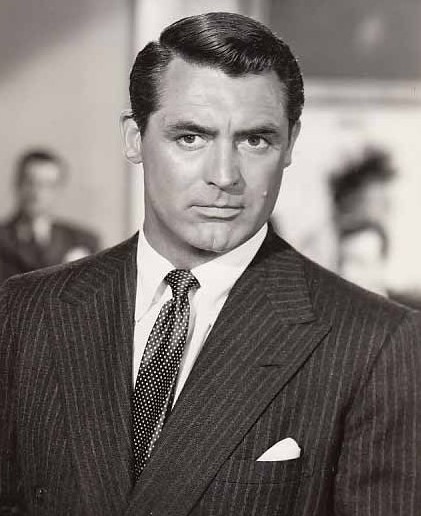
Alma was the cook for Cary Grant, the article states, and she had been sued by 22-year-old blonde Jean Bowen after an incident several weeks earlier on December 24, 1946, at a drive-in restaurant.
The Pouliets and Jean and her husband Jack were sitting next to each other in booths, and Jean apparently objected to the Pouliets speaking French, seemingly because she thought she overheard Alma calling her a “pig” (though whether this was after she objected is unclear). Anyway, a scuffle followed between the women, and Jean alleged that Alma tore her clothing.
In court, the feisty Alma joyously admitted “I called her worse than that, but her high school French is no good, and she misunderstood me.” The “jabberer” then had her 30-day jail sentence suspended, and paid a $10 fine “with a smile.”
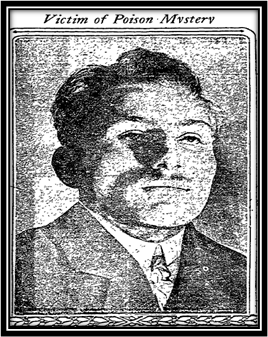
In the “aftermath” it seemed the Pouliets had been divorced, presumably in part because Joseph had been arrested for carrying a knife and threatening Jean. And of course, Jean (picture below, left) and Alma (right) were suing each other for $10,000 damages.
There are maybe one or two Friday 13ths every calendar year – sometimes there are none – but on this Friday 13th September 2024, I thought I would list some of my favorite (and most mysterious) mysteries from Gourmet Ghosts. What do you think happened?
The “Ghost Woman Sought” headline is from November 1922, when rancher Vaden Elwynne Boge was poisoned at the Alexandria Hotel. Police searched for his wife, who was suspected of the crime, but never found her…..
The man in the collar and tie is Ludwig Steiner, a clerk and resident at the Barclay Hotel in 1915 – until he disappeared suddenly among rumors that he was German spy. Steiner spoke seven languages, and among the possessions he left behind was a picture of him in the uniform of the Austrian army. He said he had been arrested while in Japan and charged with espionage too… but was all that true?
A severed leg? One was found in 1895, wrapped in pages from a newspaper, at the downtown LA address that’s now the STILE Hotel (and was built as the United Artists Theater in 1927). The United Theater still operates there as an events venue – and it is said to be haunted (but by any one-legged ghosts?).
Also below is a picture Chinese-Canadian tourist Elisa Lam, and the Cecil Hotel. If you don’t know about her bizarre 2013 death here in the water tank – then just Google it!
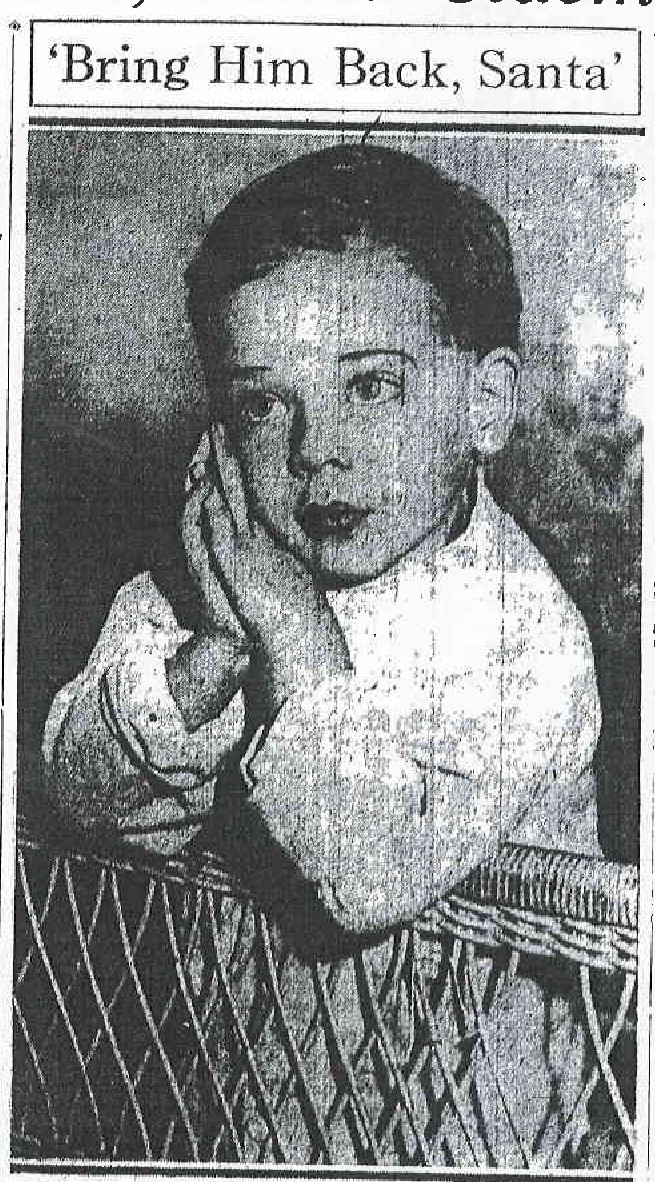
That sad picture of that kid praying to Santa (?) is from December 1925, and poor “Buzz” Reeve, 3, wants his dad, Raymond, who had gone from LA to meet a business contact at the Hoover Dam, near Las Vegas, to discuss a lucrative contact – and had not been seen since. It had emerged that this meeting seemed to be a scam – or a trap….
Finally, that’s a picture of Elizabeth Short from the Historic Corridor at the Biltmore Hotel, the last place she was officially seen alive in 1947. A few days later, she was found brutally murdered – and is known to his history now as “The Black Dahlia.”
You can read more about all of them, of course, in the Gourmet Ghosts books….
We recently returned from a trip to Australia, visiting Melbourne and Hobart on the island state of Tasmania. Both cities have some excellent ghost signs – you can see them in earlier posts here – but I thought I would show you the new ones from Hobart…
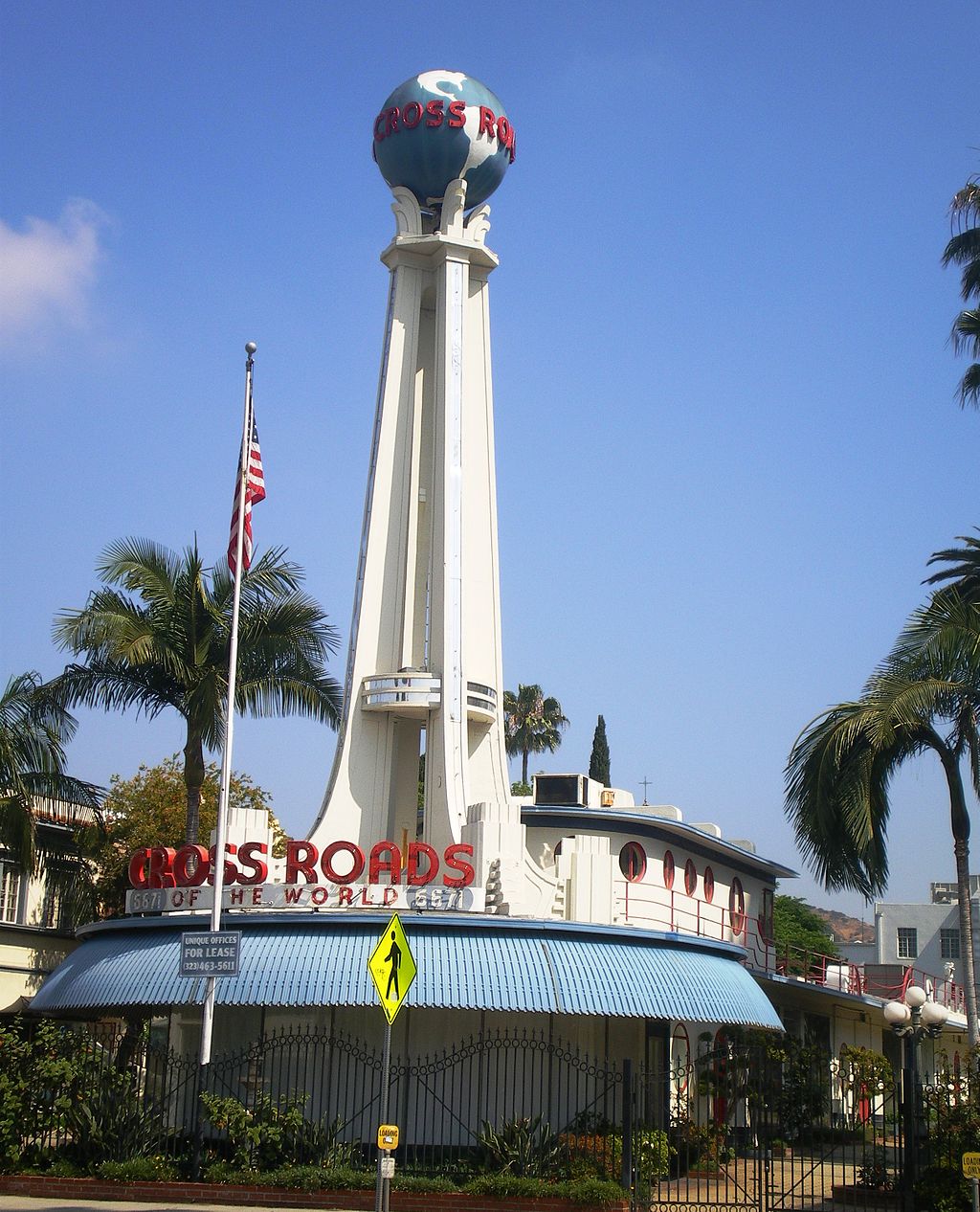
When it was built in 1936 it was touted at the first outdoor shopping mall in America, and was given an international theme – hence the impressive name. That theme was literally built in, as you can tell from the Streamline Moderne ocean liner that looks like it has just docked among a number of foreign-styled bungalows.
The seven bungalows represented Spanish, Italian, French, Moorish and European architecture (as well as colonial New England and early California for American visitors), and they were planned as café’s and unique stores on the street level, and offices above (one of which was leased by Alfred Hitchcock).
There are other maritime elements here too – portholes, catwalk, a statue of a large pelican, a “lighthouse” at the back – and of course the huge Art Deco tower, which soars 30 foot above Sunset Boulevard and has a spinning white and blue globe on top with a bright red neon sign.
A landmark in Hollywood from day one, it was designed by Robert V. Derrah at a cost of $250,000, and his love of the sea is evident in another of his L.A. buildings, the Coca-Cola Building in South Central, a bottling plant that he built before the Crossroads and also looks like an ocean liner sailing the streets.
The mastermind behind the Crossroads development was Ella Crawford, who clearly had a love of – and connections with – the world of movies and the theatrical. On opening day, October 29, 1936, the LA Times reported there were foreign musicians, groups of native dancers and folk singers, while stars including Cesar Romero and Boris Karloff greeted guests at their native bungalows.
The opening night was as glittering as a movie premiere, though it’s hard to believe that many of the guests there didn’t know this building was born out of murder – and that Crawford’s determination to build the Crossroads was because her husband had been killed here.
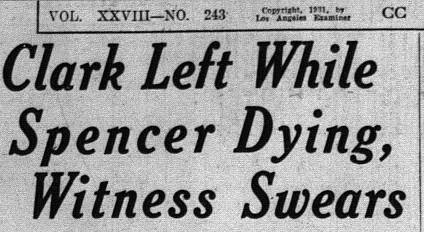
That was the LA Examiner’s headline in on August 11, 1931, when Angelenos followed the story of a double murder at this address. Former deputy D.A. David H. Clark had been accused of killing Ella’s husband, Charles H. Crawford, a crooked gangster and politician known as “The Wolf of Spring Street,” and another man named Herbert Spencer, at Crawford’s real estate office here.
A witness said he had seen Clark leaving soon after hearing several gun shots – and it emerged Clark had bought a .38 Colt revolver the day before (the same bullets as found in the victims).
But Clark claimed the two men had pulled a gun on him, telling him to back off on his threats against the underworld, and wanting him to help them frame the Police Chief.
It sounds like the perfect noir story, and it certainly had all the ingredients: the handsome D.A., the crooked guys, a gun, dead bodies and a question: was it murder or self-defense?
Clark was tried twice – a mistrial and then acquitted – but just months after the Crossroads had been opened by widow Ella Crawford, he went missing but was found in France, apparently “insane.”
He didn’t escape criminal punishment forever though; he was later was convicted of murder at a drunken party, and died soon after starting his sentence in Chino Prison in 1954.
Crossroads of World was a memorial of a sort for Charles Spencer, and it seemed like a glamorous, winning concept. You could buy cigars, or handkerchiefs, or Asian art, or French dresses, or get a haircut in the latest style, and though celebrities and the public loved it for a while it didn’t last very long, and soon became more offices than stores.
It did get Historic-Cultural Monument status in 1974, but by then it was dilapidated and due to be demolished for – of course – a skyscraper, but developer Morton La Kretz bought and restored it, adding fountains and some other touches to the old style.
It was a music business favorite from the 1970s onward too: Jackson Browne, Bonnie Raitt and Crosby, Stills & Nash recorded and rehearsed here, as well Fleetwood Mac, Gladys Knight, Patti LaBelle, BB King, and America, who put the Crossroads Tower (surrounded by grass and palm trees) on the back cover of their album America’s Greatest Hits.
Over the years it was of course featured in television shows and movies like Indecent Proposal, LA Confidential, “Dragnet” and “Remington Steele,” and in plenty of commercials and pop videos. Also, if you’re ever in Florida at Disney World, you’ll see a reproduction of the tower and globe inside the entrance to Disney’s Hollywood Studios.
Today it’s home to music companies, writers, production companies, and many more movie-related businesses – though there’s no restaurant or bar for them to hang out at, so it doesn’t fully qualify for Gourmet Ghosts 2.
Even so, it’s often easy to wander the “streets” of this unique and rather weird piece of L.A. history….
In early January 2023, there was the sad news that an employee of a building on Broadway in downtown LA had been killed in a elevator accident there. During recent talks and Zooms, I’ve found that people are both fascinated and repelled by such (often grisly) accidents, probably because in many ways it’s the ultimate nightmare.
Rare as they are today, I did a search through the Los Angeles newspaper archives and found that a hundred years ago or so they were more common than we might imagine, especially in hotels and banks. There are a couple of reasons for this. Firstly, in the early days many people were not used to elevators, which is why there were so official operators.
Moreover, they were not automated, meaning that the doors – if they had them – didn’t open and close automatically when they reached a floor. Nor did they have sensors that would stop/re-open doors instantly when someone tried to get in or out.
Also, many elevators were powered simply by a stop/go lever, and the counterweights often weren’t distant or encased away from the carriage. Also, with sliding concertina metal gates it was easy to pull them back if you wanted to (stupidly) peer into the shaft. Many people also didn’t look before they stepped into the carriage – which wasn’t there yet (or had under or overshot the stop).
The lucky survivors of shaft falls often sued, which is probably part of the reason they became safer, but many didn’t survive, and these are some of the stories I found – including one building where three employees all died in separate incidents.
Van Nuys Hotel (103 W 4th St)March 4, 1897 – Waiter Charles G. Gamble and the elevator boy, Robert White, were going down to the first floor and “joking” together when White turned the lever the wrong way, and it began going up again.
Having “lost their presence of mind,” White jumped out of the still-moving elevator at the third floor and Gamble, apparently frightened, tried to follow him out – but too late. Caught in the doorway, the rising elevator then pinned his legs, which “snapped like pipestems…”
The Los Angeles Times went on to graphically describe how Gamble’s body was dragged up by the foot until “that was smashed” and he fell head-first to his death, his skull fractured in multiple places and his left eye actually torn from the socket.
Amazingly Gamble was still alive, but “after nearly an hour of intense suffering,” he died in hospital.
Van Nuys Broadway Hotel (4th & Broadway)January 3, 1900 – Tragically (and creepily) a second hotel named the Van Nuys Broadway and also owned by the same person as the Van Nuys).
Bell boy Earl Newton, aged just 16, was on top of the elevator cage when he accidentally pulled on the power rope, causing the elevator to rise and trap him between the shaft and the ceiling on that floor. His internal organs were instantly crushed, and the blood rushing to his head turned his face purple.
Van Nuys Hotel (again)September 21, 1901 – Joe Kato, a Japanese assistant janitor, couldn’t overcome his curiosity about the open elevator shaft, and peeked into the darkness.
Predictably – and horribly – he was hit on the head by the 4800 lb counter weight that went down as the elevator went up, and was killed instantly.
Hellman Building (411 S Main St, besides the Stowell Hotel/El Dorado Lofts)February 8, 190 – Head janitor Chris Larsen was hit by the descending cage of the elevator, and killed instantly. “Nearly the whole top of his head was torn off, and the unfortunate man’s brains and blood were spattered along the sides of the elevator shaft from the fifth floor to the basement.”
He had been standing on the top of another elevator cage, cleaning the ironwork on the inside of the shaft, and had leaned out several times – and been warned to be careful – but he laughed off any concerns: something that turned out to be a deadly decision.
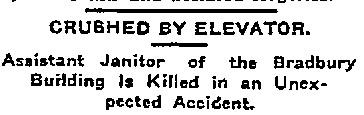
Bradbury Building(304 S Broadway) November 22, 1908 – The head janitor was looking for his assistant, 34-year-old Carl King, but couldn’t find him anywhere – until he looked down the elevator shaft and saw his body, which had been there for several hours.
King’s skull had been crushed and many bones broken, and it emerged that he probably got caught between the 2nd and 3rd floors, and had been hurled about 35 feet to his death.
Alexandria Hotel(501 Spring St) December 22, 1910 – Two men were killed and two injured when the platform they were standing on in the elevator shaft, which also had barrels of plaster on it, collapsed.
Ernest Pearman and Joseph Lawrence, both plasterers, fell seven floors; Pearman’s skull was crushed and he died at the scene, but Pearman, also with a skull fracture and several ribs that had punctured his liver, lingered for several painful hours in hospital.
The other two men, Stephen Smith and Charles Lentz, managed to grab something and save themselves; they only suffered cuts and bruises.
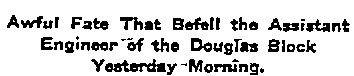
Douglas Building, 257 S. Spring StDecember 20, 1905 – Clifford J Rudd, engineer of the building for past four years, entered the counterweight shaft and stood on a small platform he had constructed to adjust the tension of cables.
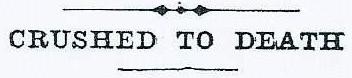
The elevator car was at the bottom of the shaft, and what happened next was unknown, but his body was found lying across an iron beam, crushed under that counterweight.
March 31, 1941 – 80 year old elevator operator WP Brown ran to get into the elevator but was too late, and fell three floors down the shaft to his death. Apparently he had been unwell…
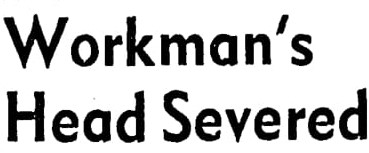
February 18, 1948 – John Goris, a 50 year old carpenter, was decapitated when the elevator balance weight struck him on the back of the neck. Goris had been working on an elevator repair, and put his head through a hole in a wall – and was hit by the weight.
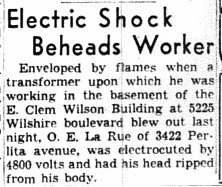
Related to that:May 6, 1945 – down in this basement at the E Clem Wilson Building at the corner of Wilshire/La Brea, when Bureau of Power & Light engineer Orin E. LaRue was working on one of the transformers when it accidentally exploded. He was electrocuted by 4800 volts, the shock setting him alight and – horrifically – ripping his head from his body.
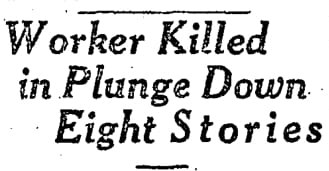
Roosevelt Building (7th & Flower)January 7, 1927 – Laborer R. Ponce, 45, slipped into an empty elevator shaft and fell eight storeys to his death.
Spring Arts Tower (453 S Spring St)July 4, 1927 – Kevin Taylor, history graduate and former manager of the Spring Arts Tower, has done considerable research on the building, and he said that it has plenty of spooky stories:
“I first came here about seven years ago, and the third floor was like an abandoned old school. It must have been an adult vocational school because there were still desks there, old computers, chalkboards and even old gurneys – they must have taught nursing there too.”
It seems that the night watchman is still making his rounds on the 3rd floor; there have been reports of a ghostly figure going around opening and closing doors and the sound of a bunch of jingling keys.
Employees at the Citizens National Bank heard a man groaning around 10am the previous day, but could not find anyone in distress.
It emerged that sometime during the previous night watchman Al Brietenbecker had fallen from the 3rd floor down the freight elevator shaft to the sub-basement, severing a major artery in the fall. Evidence showed that he tried frantically to staunch the flow of blood with torn pieces of his own clothing, but his efforts were unsuccessful and his dead body was found around midday.
Los Angeles Courthouse November 25, 1927 – It appeared that “Congo”, a rat who had gotten fat off eating first the contents of a sack of peanuts that were evidence – and then from countless pieces of cheese left out in traps to try and catch him – had committed suicide by jumping down the elevator shaft.
Congo – who had also allegedly grown whiskers a foot long and had a huge, furry coat after apparently eating a Judge’s bottle of hair restorer, was best friends with Megan, a gray-haired stray cat that had become the Courthouse cat – and, instead of chasing down Congo as the employees hoped, had in fact become Congo’s best friend.
The pair were often seen together, both on the roof and inside elevators, and even sometimes climbing the sides, scaring passengers. But recently it appeared that Megan had been run over and killed on Temple Street, and it seemed that Congo could not live without his (or her) best friend….
Christie Hotel, Hollywood (now Scientology Building 6724 Hollywood Blvd)September 1, 1943 – Albert Bellerose, 28, an elevator operator who had only worked at the Christie for three days, was killed.
His head and neck were “crushed” when he was somehow dragged into the narrow space between the lift and the shaft. Witnesses said they heard a scream, and saw his legs extending from the top of the elevator door.
The fire department had to be called to “extricate his body.”
Spring Arcade(541 S Spring St)January 30, 1946 – Ernest C. Bean, 55, an employee for the Spring Arcade, tried to jump onto a sidewalk elevator in the basement, but mistimed his jump and was killed instantly when his body was crushed against an overhead beam.
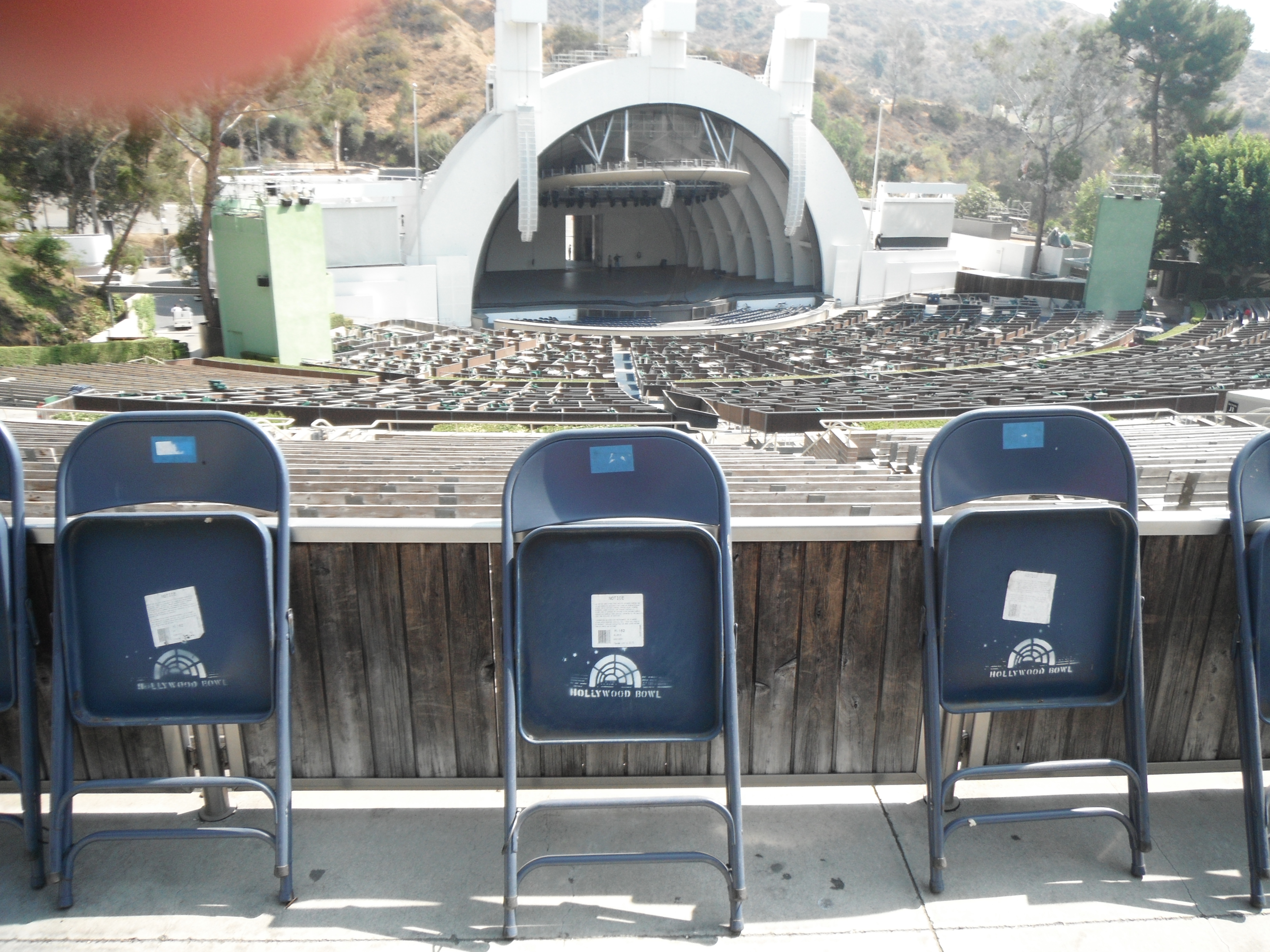
Perhaps the most famous music venue in the world – and one of my favorite places in Los Angeles – the Hollywood Bowl becomes a centurion on July 11, 2022. I’ve written about it often (including recently for the LA Times), but here’s something bite-size and fun. If you want, you can find out way more at the Bowl’s own website….
The Hollywood Bowl
Almost every major music artist – except for Elvis Presley – has played at the Bowl over the last century.
It has also hosted opera, ballet, circuses, presidents, religious revivals and Monty Python, among others, and during the roughly June-September season this year, over a million people will come to enjoy a show and see its spotlights shine across the night sky.
The fireworks concerts are particularly popular when darker nights arrive – there are around 1,600 colourful explosions at each one.
For its first concert in 1922 the admission price was 25 cents, and people still find it hard to believe that today you can buy some $1 tickets for performances by the L.A. Philharmonic Orchestra.
Admittedly those seats are up in the gods (it’s 168 stairs from the stage to the back of the Bowl), but the large digital screens mean you won’t miss anything, and there’s a good chance you’ll see internationally-known soloists and performers, let alone the orchestra’s popular conductor, Gustavo Dudamel.
Originally a collection of rickety benches and a wooden, temporary stage, this natural ampitheatre in Griffith Park was first called “Daisy Dell”, and the first of their iconic white shell stages was installed in 1926.
There have been four more since, the first three only lasting a year each as the Bowl staff tried to work out the best shape to reach audience ears. The 1929 incarnation ended up on the official Los Angeles County seal, and it was “temporary” for 75 years, until it was fully replaced in 2004.
Reminders that the 88-acre Bowl is located in the wild – Griffith Park is over 4,200 acres in size, one of the biggest public parks in North America – have often been part of the Bowl’s history.
Six raccoons, presumably a music-loving family, once hung on the shell arches during a concert, and a fox once walked on stage and sat behind a pianist. Bats flit around overhead before the music starts, coyotes can sometimes be heard howling, and at the end of the evening it’s not uncommon for deer to emerge from the trees and snaffle up the leftover popcorn (well, what’s left of the 29,000 pounds sold every season).
The record number of tickets sold was 26,410 for a performance by French opera star Lily Pons in 1936. It will never be beaten, as the current limit is less than 17,500 – though many of them offer an amazing view of the Hollywood sign on Mount Lee opposite.
Over 700 are garden and terrace box seats, which seat up to six people each and are popular with celebrities, though fame and fortune is no help if it rains. It’s an entirely outdoors venue, and if the heavens open everyone gets the same emergency plastic ponchos – though that’s such a rare event, most people just leave early to beat the legendarily-bad traffic.
Finally, seats Q3 and U3 in row 9 are the only two-seater benches, and popular with couples looking for a romantic night under the stars. There may well have been proposals here at the Bowl over the decades, but it will be hard to beat what happened in 1928, when composer Percy Grainger and Swedish poet Ella Viola Ström were married on stage – right after he had finished his performance!
Oh, and yes: the Hollywood Bowl does feature in my books – specifically Gourmet Ghosts 2. An amazing picture, I think you’ll agree – but you’ll have to buy the book to find out the story behind it….
When I was a child, I was always warned against playing or hiding in refrigerators. This always seemed ridiculous to me; fridges were cold, and everyone knew the light went off when you closed the door, so why would you want to sit in the freezing dark?
That said, I do remember that many homes had, and still have, huge chest freezers. They didn’t stand upright, but instead rested lengthways – rather like a coffin, in fact – and some of these had latching handles that clicked shut.
They were the perfect size for hiding, but even then I wasn’t convinced that the stories of children being found frozen to death after a playtime game went horribly wrong could possibly be true.
But then I started researching the LA Times archives for my two Gourmet Ghosts books, and I came across a number of upsetting reports about just that: children who had hidden in fridges (or the even more basic ice boxes, as they used to be called) and found themselves unable to get out. They had died of the cold, or starvation, or even suffocation. Or a combination of all three.
It happened often, and not just in houses: children were found dead in broken fridges left on wasteland or at garbage dumps too. It was surely a terrifying, slow and lonely way to die, so imagine my surprise when I found out that some adults actually chose to climb into a fridge to commit suicide.
On February 4, 1955, Joseph M. Parker from Long Beach registered at the Hotel Wellington in downtown San Francisco. Sometime during the night he made his way to the kitchen, unplugged the refrigerator, attached a piece of string to the inside of the door, and then used it to close the door behind him. He left two suicide notes.
On June 13 that same year, 68-year-old Edith Boyd used a similar method to climb into the fridge in the garage of her cousin Berthina Clementson. Berthina and her husband had gone out to a housewarming, but Boyd, who seemed in good spirits, had declined to join them. She was reported missing the next day, but then her body was found: she had suffocated to death.
On May 10, 1968, the LA Times reported on the suicide of 17-year-old William B. Moore, an outstanding San Bernardino student who was described as a “Boy Genius.” The fridge was in a shed behind the house, and after removing the shelves, Moore climbed in. He was carrying a flashlight, his diary, and some sleeping pills.
Moore wrote that he had “sealed the inside with masking tape,” and that the pills had an “awful taste,” as she slowly faded away. “Goodby”, “thanks”, and “love” were a few of the other legible words, and it emerged that he had posted letters to four friends telling them of his plan to take his own life. But his friends, parents, teachers and police were mystified about the reason why.
On July 9 that same year in Arcadia, 55-year-old Juanita Lanferman was found dead at her home, “jammed” into a three-foot-tall refrigerator. There were no indications of a struggle, but police were waiting for a detailed autopsy to confirm if she had died of suffocation…
Makes you look rather differently at the huge refrigerators we have today – there’s certainly plenty of space in them, isn’t there? No wonder they’re also used by killers. And it certainly makes a bit more sense now when you get told “Stay away from that fridge!”
I am a big fan of the Bonaventure Hotel in downtown L.A., and I’ve written about it for Atlas Obscura and many other places. If that name is not familiar to you, you’ll definitely recognize it from movies such as Inception, True Lies, Strange Days, In the Line of Fire, “Buck Rogers in the 25th Century”, and more.
It’s the shimmering glass structure that looks a bit like a rocket ready to launch, and, irresistibly, it has a rotating lounge on the 35th floor (one of the few working ones left in the USA). No wonder the gull-wing, stainless steel DeLorean DMC-12 used it as a backdrop in promo images in the 1980s.
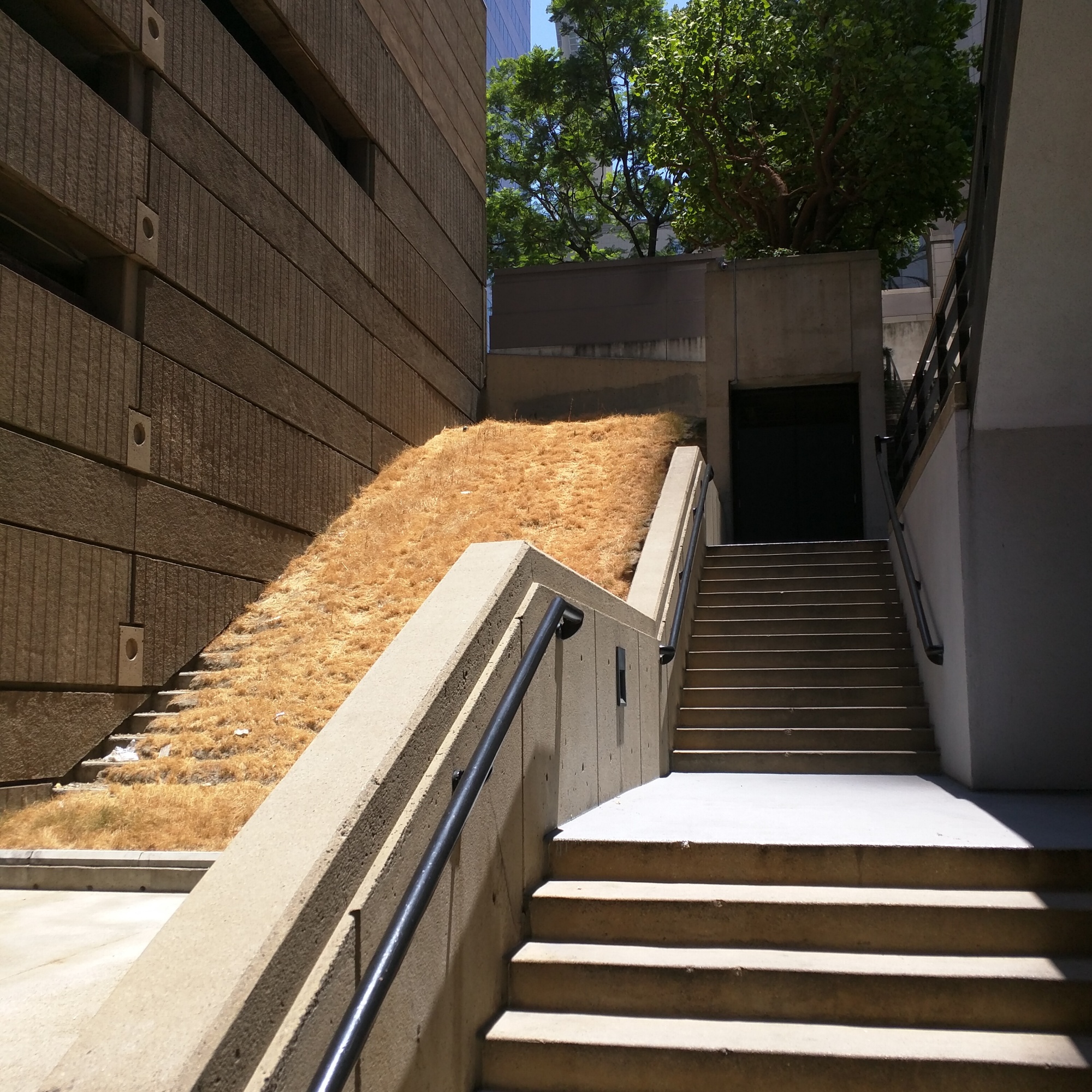
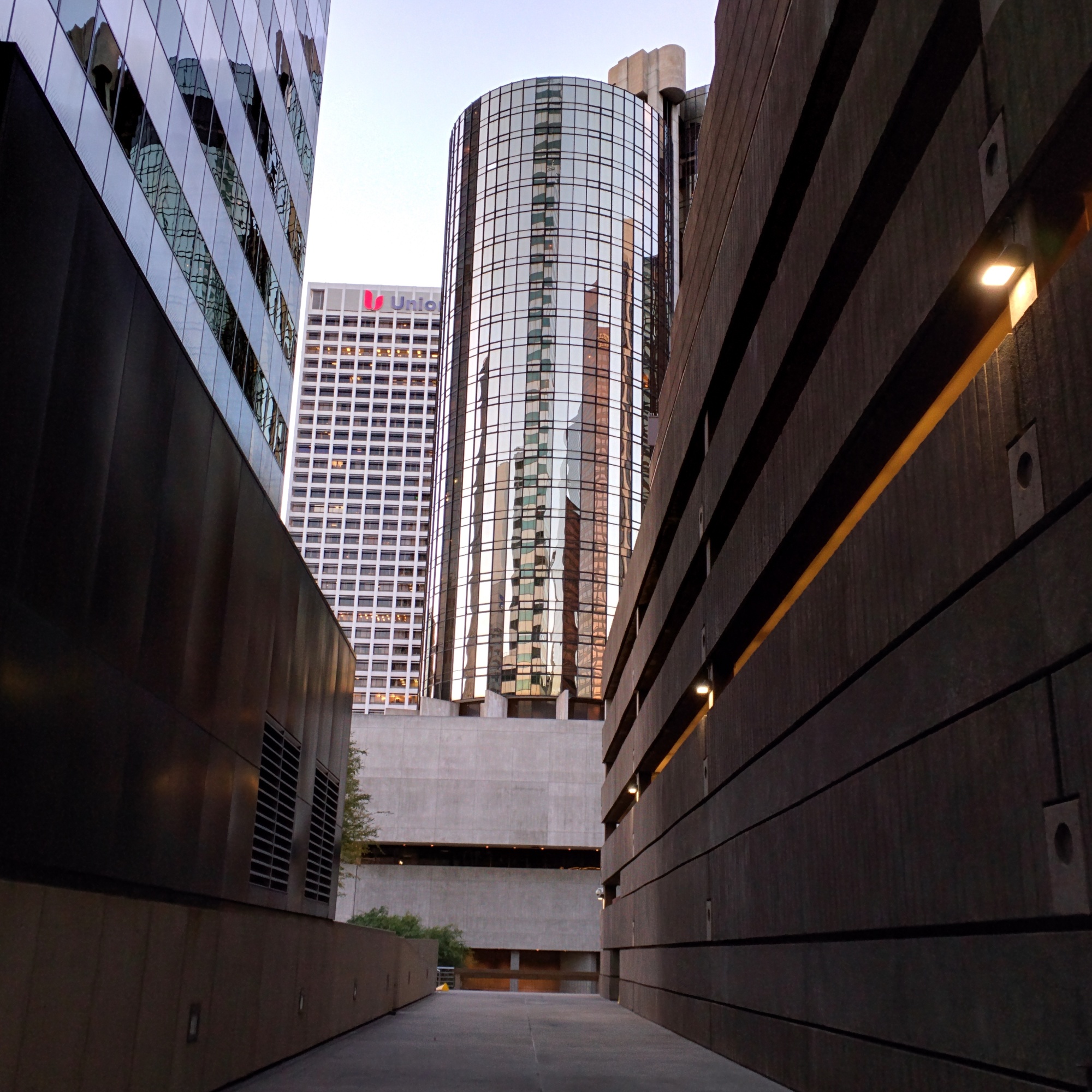
Anyway, on one of my many stays – and walks – the Bonaventure complex, a series of strange, abandoned, grass-covered concrete steps across one of the pedways from the Bonaventure caught my eye.
They were at the end of a featureless alley of the Citibank Center, between two buildings, and they went up to come to a stop at a brick wall: they literally lead nowhere.
I worked out they presumably once been a walkway to the US Bank Tower area, and I could even see the stairs through a small gap in that same brick wall, looking back at the Bonaventure from where I had come.
But when were they blocked off, and why? I set off down a rabbit hole to try and find out, and though I was able to get blueprints and maps from the city, I was never quite able to find out what the story was behind these lonely stairs to nowhere. Do you know?
Even so, I thought you might appreciate a few pictures. Next time you’re downtown, go and find these stairs and check them out – they’d appreciate a visit!
Today we’re used to people being conned or “catfished” by falling for someone they unwisely “meet” through social media, though the old term “lonely hearts” is still used to describe this kind of cruel deception.
The term originated when people would write what we’d know today as their “profiles” and send them, alongside their home address, to be listed in special columns of newspaper and magazines, with the plan to start a romance (or just a friendship) via letter-writing.
In 1950, a scam like this happened in Hollywood when Mrs. Claude J. Neal, 55, was conned by George Ashley into signing checks for $17,500. Ashley said he wanted the money for a deposit to buy the El Patio (now the shuttered Emerson Theatre), and promised her a job as hostess.
Though the married Neal said she had only joined the newspaper club to find friends, she did spend time with Ashley – though always denied there was any romance between them.
Either way, Ashley called her a “North Carolina hillbilly,” and once pulled out a gun and told her he didn’t want any more “monkey business.” Humiliated and ashamed, Neal finally went to the police after a frightening trip Ashley took her on to Nichols Canyon, where he pointed down the steep cliff and said:
“If I pushed you off there wouldn’t be one chance in ten thousand that your body would ever be found. Now, baby, you’d better fly right.”
Neal was one of an unlucky 13 woman who testified against Ashley and his co-defendants. Another of the victims was Ashley’s own wife, who was now suing him for divorce. No wonder the Los AngelesHerald-Express nicknamed him “Lord of Lonely Hearts.”
Swimming To Heaven (or Hell)
There are several notable historical stories of people going to a beach – or even out on a sailing vessel – and never being seen again. One of those happened here in Los Angeles, but in this case, it seemed the missing husband came back from the dead. Well, not quite.
On June 1928 the LA Times reported that Ferdinand Albor had been arrested in San Pedro for burglary. Police linked him to a smelter who had recently been nabbed for handling stolen gold and silver, and it emerged that Albor had been part of a San Francisco-based gang, but moved his operation to Los Angeles a year or so before.
There didn’t seem to be anything unusual about this until, a few days later, it was reported that K.L. Baumgartner, whose clothes had been found on a beach in Venice, California, some four years ago, had come back from the dead.
Albor the burglar had confessed to police that he was in fact Baumgartner:
Burglar Albor, really the missing man KL Baumgartner
“I was not drowned in the ocean, but fled because of an inner force that keeps me moving whether I really want to stay or not.”
Unhappily, Baumgartner’s wife – who had only been with him for four months before he “disappeared” – had remarried in the meantime, and, in a twist that seemed similar to the plot of the Irene Dunn/Cary Grant movie My Favorite Wife, she now needed to obtain an annulment and re-marry her new husband, a process that would take at least a year.
Baumgartner/Albor told detectives that he had received a head injury while working in the Seattle shipyards during WWI and “since then, I have not been wholly able to control my actions.” He and his wife had once owned a restaurant on Main Street in downtown L.A., but one day he “felt an irresistible urge to leave,” and he had worked as a cook in logging camps and “other out-of-the-way places” ever since.
An odd meeting between the Lazarus-like Baumgartner and his remarried wife took place in the County Jail, with Baumgartner whispering “How do you do?” before their awkward conversation began. He pledged to help her “regain her freedom,” while the shell-shocked woman simply told reporters that she and her new husband Robert Busby were happy together.
April Fools’ Day– sometimes the joke is on you…
It’s still a tradition amongst the mass media to plant a seemingly-false story on April Fools’ Day. Many places collate all their strange stories from the year so far, and then report them all on April 1 just so that readers (and their rival colleagues) can guess which one is the fake.
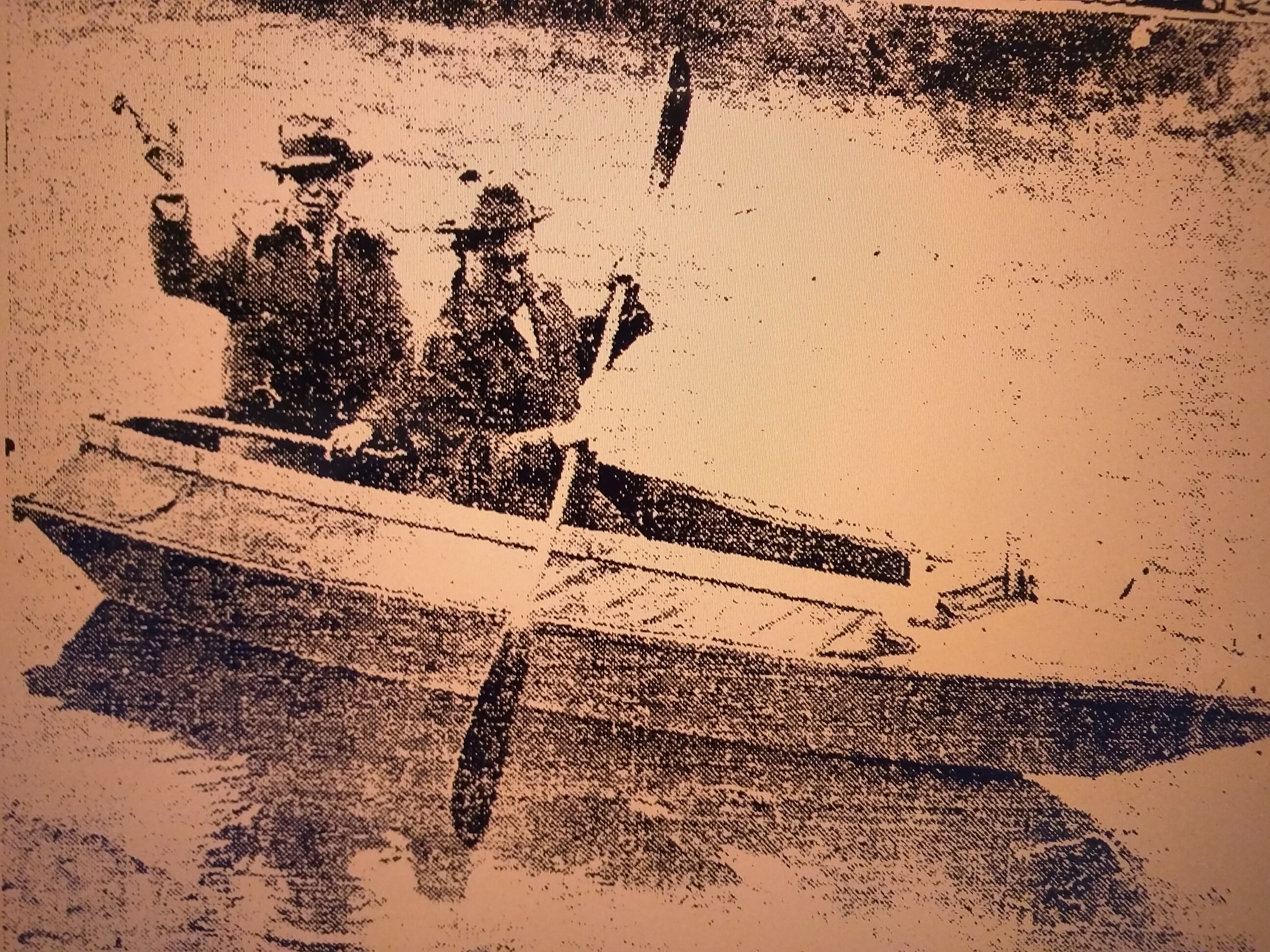
On April 1, 1925, a fun picture showed two suited men – a kayaker and an LA Times reporter – navigating a kind of kayak along the Los Angeles River, which at the time was more known for floods, pollution, and anything other than what we’d think of when we hear the word “river.”
Ironically, the joke turned out to be on the jokers. In 2008 a group of kayakers did indeed navigate the 51-mile concreted urban river, and paddlers can now indeed travel small sections of the L.A. River – it’s great fun. The cleaned-up L.A. River is now at the center of a huge, billion-dollar scheme to revitalize whole stretches, and the future should be a whirl of bike lanes, fishing, parks, sports, eateries and more.
Despite it being a real scam, the idea that a conman once tried to sell the Eiffel Tower in Paris, France, to gullible tourists has become an urban myth. There have been legitimate sales of California landmarks – pieces of old Hollywood signs or the Santa Monica Pier ferris wheel – and the legend about selling London Bridge is real too.
In 1968, pieces of the deconstructed 1832-built London Bridge passed through Long Beach on their way to Havasu City, Arizona, where it was carefully reassembled and still stands over the Lonn Colorado Rover.
At one stage Universal Studios were said to want it for their studio tour, but they pulled out of the running. Seller Ivan Luckin always laughed off rumors that the eventual buyers who paid over $1m actually thought they were getting the more famous Tower Bridge, but it could explain why Universal suddenly got cold fee
Part of London Bridge arrives in Long Bceach
Tower Bridge – did the Arizonans think they were buying this?
L.A’s human hoaxes go back as far as 1895.
On April 1st (which should have been a clue), the LA Times reported that residents of Sonoratown (now Chinatown) had called police to say that that someone had committed suicide at the Monkey Saloon, and was lying dead on the floor.
Two off duty policemen, a deputy coroner and reporters from the Herald and Express newspapers went to investigate, but all they found was a dressed man of straw (like a scarecrow or doll). It was a hoax, and of course the Times reporter – who, naturally, had suspected this all along – had stayed at home and bested his hack rivals!
One of my favorite stories in Gourmet Ghosts – Los Angeles was a hoax, and it happened at the Alexandria Hotel, once home to Fred Astaire, Humphrey Bogart, Charlie Chaplin, Joan Crawford, Clark Gable, Greta Garbo, and Mae West.
The “Alex” opened in 1906 and stood right at the center of L.A.’s budding movie industry (it was here in 1919 that Mary Pickford, Charlie Chaplin, D.W. Griffith and Douglas Fairbanks created their United Artists studio and many early movie companies based their offices).
The hotel is said to be the home for several ghosts, and on November 28, 1922 the Los Angeles Examiner headline screamed:
Wealthy, young Oregon rancher Vaden Elwynne Boge had registered himself and his wife at the hotel, saying that she would be coming later with their luggage. He was given a room on the 4th floor, yet no one saw a woman or any luggage arrive before he ordered lunch for two from room service: the “Death Luncheon Menu” was chicken sandwiches, rice salad, two pieces of pie, and cranberry sauce.
The room service waiter saw no one else in the room, but soon after, houseman James Hirst heard cries, and Boge staggered into the hall shouting:
“I believe I have been poisoned. Get a doctor!”
Boge died soon after, and one of the coffee cups was found to contain potassium cyanide while the other was half-empty – yet there was still no sign of any other person, let alone his wife. Boge’s family thought he was engaged to be married, but even after questioning the hotel staff the police were still in the dark, and a search of the city’s docks was ordered.
The newspapers showed a picture of the lunch tray, complete with its crumpled napkins and coffee cups, but within a couple of days all was revealed: it had been an elaborate suicide plot that the Los Angeles Evening Herald suggested had been inspired by a short story called The Guest by Lord Dusany.
It turned out that Boge himself had bought the cyanide, and had apparently been “melancholy and morose” and “blue” for months, possibly due to ill-health. More shockingly, there were also rumors of love for a cousin.
“Boge feasted to death alone” was the headline, and the real reason behind his “self-destruction” was probably en route in the mail; Boge had apparently written to his mother two days before he drunk the fatal dose.
An unlucky thirteen year later, former boxer Thomas Watkins admitted in court that he had faked a story about being kidnapped at gunpoint – not once, but twice – by three men who wanted the address of actor Victor Jory, who had been his boxing manager. Watkins said that the men told him they planned to kidnap Jory’s five-year-old daughter Jean, and hold her for ransom.
The kidnap and murder of the Lindbergh Baby in 1932 had been an international sensation, and there was a rash of kidnaps – real, threatened and botched – in that decade, as criminals felt it was an easy way to make some fast cash. Even when Watkins confessed, Jory was still spooked enough to send Jean out of state.
The reason for Watkins’ frightening lie? He wanted to drum up some publicity for himself.
























 Gourmet Ghosts