April Fool’s Day: Part 3 – Scams

The Lonely Hearts Scam

Today we’re used to people being conned or “catfished” by falling for someone they unwisely “meet” through social media, though the old term “lonely hearts” is still used to describe this kind of cruel deception.

The term originated when people would write what we’d know today as their “profiles” and send them, alongside their home address, to be listed in special columns of newspaper and magazines, with the plan to start a romance (or just a friendship) via letter-writing.

In 1950, a scam like this happened in Hollywood when Mrs. Claude J. Neal, 55, was conned by George Ashley into signing checks for $17,500. Ashley said he wanted the money for a deposit to buy the El Patio (now the shuttered Emerson Theatre), and promised her a job as hostess.

Though the married Neal said she had only joined the newspaper club to find friends, she did spend time with Ashley – though always denied there was any romance between them.

Either way, Ashley called her a “North Carolina hillbilly,” and once pulled out a gun and told her he didn’t want any more “monkey business.” Humiliated and ashamed, Neal finally went to the police after a frightening trip Ashley took her on to Nichols Canyon, where he pointed down the steep cliff and said:

“If I pushed you off there wouldn’t be one chance in ten thousand that your body would ever be found. Now, baby, you’d better fly right.”

Neal was one of an unlucky 13 woman who testified against Ashley and his co-defendants. Another of the victims was Ashley’s own wife, who was now suing him for divorce. No wonder the Los Angeles Herald-Express nicknamed him “Lord of Lonely Hearts.”

Swimming To Heaven (or Hell)

There are several notable historical stories of people going to a beach – or even out on a sailing vessel – and never being seen again. One of those happened here in Los Angeles, but in this case, it seemed the missing husband came back from the dead. Well, not quite.

On June 1928 the LA Times reported that Ferdinand Albor had been arrested in San Pedro for burglary. Police linked him to a smelter who had recently been nabbed for handling stolen gold and silver, and it emerged that Albor had been part of a San Francisco-based gang, but moved his operation to Los Angeles a year or so before.

There didn’t seem to be anything unusual about this until, a few days later, it was reported that K.L. Baumgartner, whose clothes had been found on a beach in Venice, California, some four years ago, had come back from the dead.

Albor the burglar had confessed to police that he was in fact Baumgartner:

Burglar Albor, really the missing man KL Baumgartner

“I was not drowned in the ocean, but fled because of an inner force that keeps me moving whether I really want to stay or not.”

Unhappily, Baumgartner’s wife – who had only been with him for four months before he “disappeared” – had remarried in the meantime, and, in a twist that seemed similar to the plot of the Irene Dunn/Cary Grant movie My Favorite Wife, she now needed to obtain an annulment and re-marry her new husband, a process that would take at least a year.

Baumgartner/Albor told detectives that he had received a head injury while working in the Seattle shipyards during WWI and “since then, I have not been wholly able to control my actions.” He and his wife had once owned a restaurant on Main Street in downtown L.A., but one day he “felt an irresistible urge to leave,” and he had worked as a cook in logging camps and “other out-of-the-way places” ever since.

An odd meeting between the Lazarus-like Baumgartner and his remarried wife took place in the County Jail, with Baumgartner whispering “How do you do?” before their awkward conversation began. He pledged to help her “regain her freedom,” while the shell-shocked woman simply told reporters that she and her new husband Robert Busby were happy together.

April Fools’ Day – sometimes the joke is on you…

It’s still a tradition amongst the mass media to plant a seemingly-false story on April Fools’ Day. Many places collate all their strange stories from the year so far, and then report them all on April 1 just so that readers (and their rival colleagues) can guess which one is the fake.

On April 1, 1925, a fun picture showed two suited men – a kayaker and an LA Times reporter – navigating a kind of kayak along the Los Angeles River, which at the time was more known for floods, pollution, and anything other than what we’d think of when we hear the word “river.”
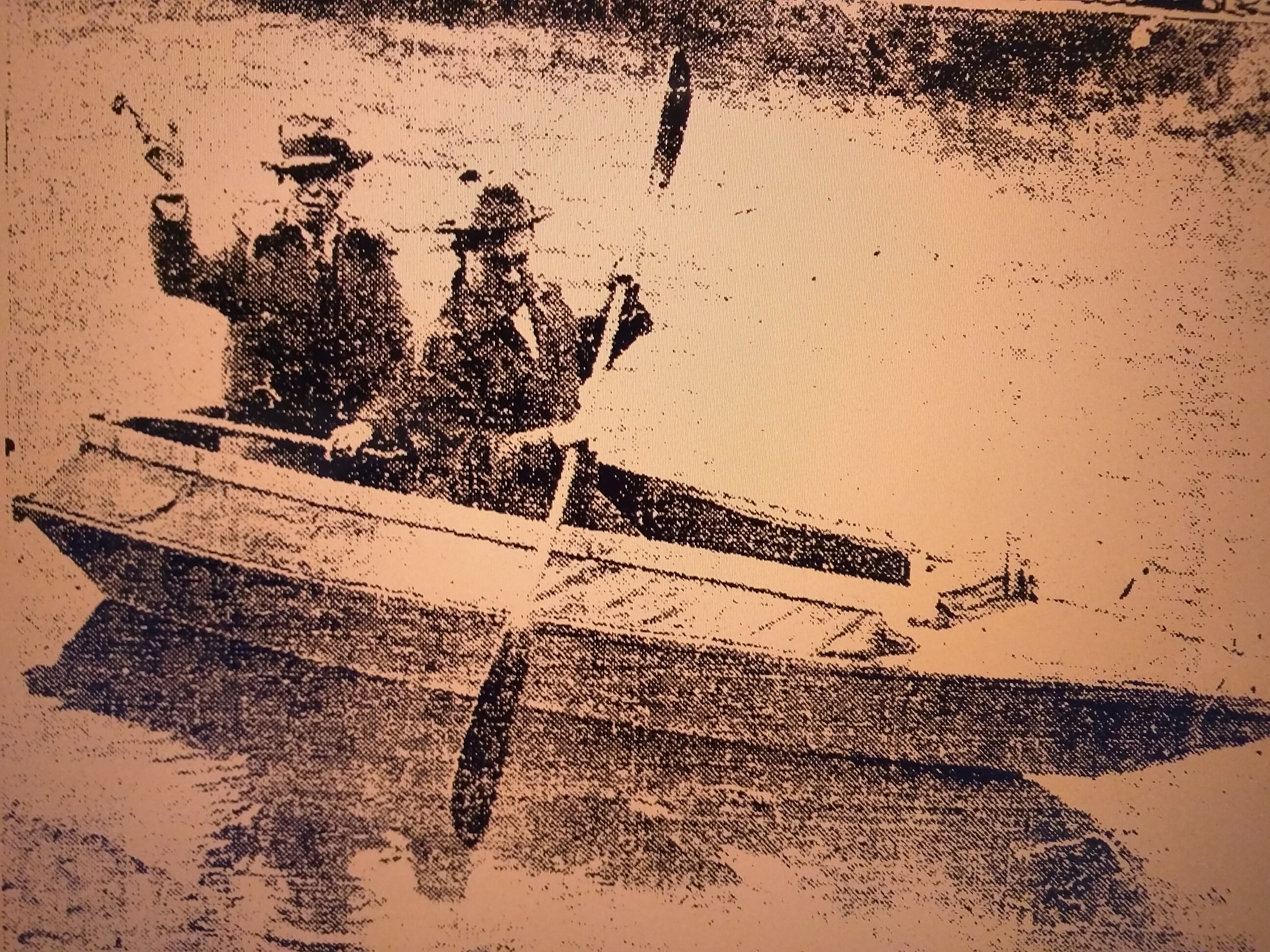
Ironically, the joke turned out to be on the jokers. In 2008 a group of kayakers did indeed navigate the 51-mile concreted urban river, and paddlers can now indeed travel small sections of the L.A. River – it’s great fun. The cleaned-up L.A. River is now at the center of a huge, billion-dollar scheme to revitalize whole stretches, and the future should be a whirl of bike lanes, fishing, parks, sports, eateries and more.

Extra! April Fool’s Day: Part 2 – Hoaxes

Despite it being a real scam, the idea that a conman once tried to sell the Eiffel Tower in Paris, France, to gullible tourists has become an urban myth. There have been legitimate sales of California landmarks – pieces of old Hollywood signs or the Santa Monica Pier ferris wheel – and the legend about selling London Bridge is real too.

In 1968, pieces of the deconstructed 1832-built London Bridge passed through Long Beach on their way to Havasu City, Arizona, where it was carefully reassembled and still stands over the Lonn Colorado Rover.

At one stage Universal Studios were said to want it for their studio tour, but they pulled out of the running. Seller Ivan Luckin always laughed off rumors that the eventual buyers who paid over $1m actually thought they were getting the more famous Tower Bridge, but it could explain why Universal suddenly got cold fee

L.A’s human hoaxes go back as far as 1895.

On April 1st (which should have been a clue), the LA Times reported that residents of Sonoratown (now Chinatown) had called police to say that that someone had committed suicide at the Monkey Saloon, and was lying dead on the floor.

Two off duty policemen, a deputy coroner and reporters from the Herald and Express newspapers went to investigate, but all they found was a dressed man of straw (like a scarecrow or doll). It was a hoax, and of course the Times reporter – who, naturally, had suspected this all along – had stayed at home and bested his hack rivals!

One of my favorite stories in Gourmet Ghosts – Los Angeles was a hoax, and it happened at the Alexandria Hotel, once home to Fred Astaire, Humphrey Bogart, Charlie Chaplin, Joan Crawford, Clark Gable, Greta Garbo, and Mae West.

The “Alex” opened in 1906 and stood right at the center of L.A.’s budding movie industry (it was here in 1919 that Mary Pickford, Charlie Chaplin, D.W. Griffith and Douglas Fairbanks created their United Artists studio and many early movie companies based their offices).

The hotel is said to be the home for several ghosts, and on November 28, 1922 the Los Angeles Examiner headline screamed:

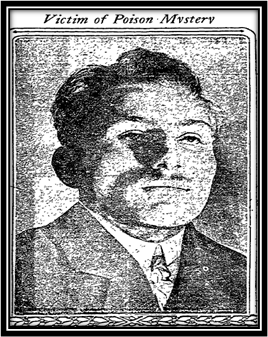
Wealthy, young Oregon rancher Vaden Elwynne Boge had registered himself and his wife at the hotel, saying that she would be coming later with their luggage. He was given a room on the 4th floor, yet no one saw a woman or any luggage arrive before he ordered lunch for two from room service: the “Death Luncheon Menu” was chicken sandwiches, rice salad, two pieces of pie, and cranberry sauce.

The room service waiter saw no one else in the room, but soon after, houseman James Hirst heard cries, and Boge staggered into the hall shouting:

“I believe I have been poisoned. Get a doctor!”

Boge died soon after, and one of the coffee cups was found to contain potassium cyanide while the other was half-empty – yet there was still no sign of any other person, let alone his wife. Boge’s family thought he was engaged to be married, but even after questioning the hotel staff the police were still in the dark, and a search of the city’s docks was ordered.

The newspapers showed a picture of the lunch tray, complete with its crumpled napkins and coffee cups, but within a couple of days all was revealed: it had been an elaborate suicide plot that the Los Angeles Evening Herald suggested had been inspired by a short story called The Guest by Lord Dusany.

It turned out that Boge himself had bought the cyanide, and had apparently been “melancholy and morose” and “blue” for months, possibly due to ill-health. More shockingly, there were also rumors of love for a cousin.  

“Boge feasted to death alone” was the headline, and the real reason behind his “self-destruction” was probably en route in the mail; Boge had apparently written to his mother two days before he drunk the fatal dose.

An unlucky thirteen year later, former boxer Thomas Watkins admitted in court that he had faked a story about being kidnapped at gunpoint – not once, but twice – by three men who wanted the address of actor Victor Jory, who had been his boxing manager. Watkins said that the men told him they planned to kidnap Jory’s five-year-old daughter Jean, and hold her for ransom.

The kidnap and murder of the Lindbergh Baby in 1932 had been an international sensation, and there was a rash of kidnaps – real, threatened and botched – in that decade, as criminals felt it was an easy way to make some fast cash. Even when Watkins confessed, Jory was still spooked enough to send Jean out of state.

The reason for Watkins’ frightening lie? He wanted to drum up some publicity for himself.

Extra! April Fool’s Day: Part 1 – Selling Thin Air & Faking Streets

Over the last 10 years or so Gourmet Ghosts has found plenty of strange, weird and even deadly things that happened in Los Angeles, so we thought we’d share them with you on this very special day. Selling thin air for millions, creating counterfeit streets, faking your own death and more. Everything you’re about to read is true. Or is it?

Selling Thin Air

Paying millions for thin air might sound like the ultimate scam, but in crowded U.S. cities like New York and Los Angeles—where property development the only way is up—owners can legally sell the empty space above their properties.

Laws concerning so-called “air rights” are said to date back to 13th century Rome, and if your building doesn’t reach the City’s height limits or sits on only part of your plot, then the clear cubic feet left behind (or above) are yours to “transfer” to someone else.  

In the mid-1980s developers of the US Bank Tower in downtown L.A. paid around $125m for the air rights of the Central Library. It was a win for book lovers, as part of the money went to the library’s redevelopment after its 1986 fire, though the 72 story US Bank Tower is no longer the tallest building in town (the Wilshire Grand Center, which opened in 2017, won that prize).

Perhaps more famous thanks to its appearance in 1982’s Bladerunner and others, the Romanesque Revival wonder that is the Bradbury Building also sold its air rights for $1m to Japanese developers in the 1980s. Since then, especially in cities like New York, prices have gone even higher.

Trap Streets

Remember Thomas Guides? Every Angeleno used to have one of these thick, bound map books in their cars, at least before the days of Waze, Google Maps and countless other traffic GPS apps.  

A 2012 donation to the Map Room at the Los Angeles Central Library included every Thomas Guide issued, and some of them had a surprise in their pages: trap streets.

Used in maps around the world for centuries, they were fictional or mis-drawn streets that were deliberately included as a way to help spot illegal copying. Some were genuine mistakes or just cartographic jokes, but often they could be reprinted for years before being removed – or not.

Librarians and collectors combed the new collection and found several fake San Diego roads in Guides from the early 1980s to early 1990s, several planned roads (and a golf course) in the SFV neighborhood of Porter Ranch that were in the 1969 edition, gone by 1977, then back in 1987, while maps in the late 1990s had a non-existent road connecting Scadlock Lane and Mulholland Drive in Sherman Oaks.

An article in the LA Times from March 1981 saw the then-VP of Thomas Brothers confessing they sprinkle fictitious names throughout their guides; he picked up a random guide on and pointed out La Taza Drive in Upland and Loma Drive in San Bernardino; both were in maps into the 1990s, but gone by 2005.

Trap streets aren’t just in California: they’re a worldwide phenomenon. There are even mystery towns and islands, and the famous London A-Z was said to have close to 100 incorrect or fake streets up until at least 2006. Map makers will usually deny this, as do Goggle Maps today, though they do place amusing “Easter eggs” in theirs.

Extra! Book Review – Kathy Fiscus: A Tragedy That Transfixed The Nation

Kathy Fiscus: A Tragedy That Transfixed The Nation by William Deverell Angel City Press, 2021, 164pp $30/£25

About now, director Ron Howard (Apollo 13, Backdraft, A Beautiful Mind) is due to start filming Thirteen Lives in Queensland, Australia. It’s the second movie adaptation of a 2018 news story that was seen around the world: the rescue of story 12 young teenagers and their soccer coach from a rain-flooded cave in Northern Thailand.

Two volunteers Thai Navy SEAL divers died during the rescue, which was broadcast, streamed, and commented on in real time, the horrific thought of anyone being accidentally lost in a dark, confined space something that terrified us all.

At the time of the Thai rescue an elderly lady in America named Alice Fiscus was asked for her thoughts, and the new digest-sized book by William Deverell explains why, as it covers the tragic story of Alice’s daughter Kathy, who fell down an abandoned metal-lined water well in San Marino, California in 1949.

Kathy was playing hide-and-seek with her sister and a cousin when she slipped or fell over 90 feet down the shaft, which was only 14 inches across (barely two thirds of the length of your arm).

Her attempted improvised rescue, and the enormous media circus (almost literally: little people, circus performers and acrobats volunteered to go down to save the frightened three-year-old), was one of the first live television news broadcasts in America.

Broadcast on radio for over 24 hours too, the event was a huge sensation. Crowds as big as 10,000 assembled to watch as ditch diggers, miners, WWII vets, engineers, police, firemen and countless others tried to help, and there was a chaotic, almost carnival-like atmosphere.   

The book features many family and rescue photographs, many of them unseen before and all arrestingly moving, and Deverell covers the period briskly but comprehensively. From a history of local water and wells, to the Famine-era Irish roots of the Fiscus family, to the chaotic and lengthy rescue attempt itself, and even tackling questions about what happened to Kathy.

The book also looks at the effect it had popular culture.

Since then, movies and television have often utilized Fiscus’s story to induce instant drama and tension, and to indicate how a family, community, country and even a world might temporarily join together in hope.

There was a television movie made of a similar 1987 incident, when 18-month-old Jessica McClure fell down a well in Texas. That attempt frequently referenced Kathy – and spoke to Alice – and though McClure had fallen around 20 feet into an even narrower space, she was saved after over two days.  

This happy ending perhaps allowed for a humorous episode of “The Simpsons” a few years later, when Bart used a walkie talkie to pretend to be a boy who had fallen down a well – and then gets stuck there himself, only to find the Springfield citizens didn’t find his prank very funny.

Perhaps most notable is the famous cliché about Lassie running to the local sheriff or adult and barking until the human cottons on: “What’s that? Little Timmy has fallen down a well?” (a storyline that actually never happened in any Lassie episode or film).

The book might have benefited from giving the reader more of a sense of Kathy as a child and sister, young as she was, because in some ways the advanced media (at least of her era) turned her almost into a generic term for childhood accidents, her actual death being almost overshadowed.

Recently the “Ghost Adventures” reality program and Netflix documentary “Crime Scene: The Vanishing at the Cecil Hotel” (the latter, interestingly, co-executive produced by Ron Howard), featured the story of student Elisa Lam, who was found drowned in a water tank (water again), atop the Hotel Cecil in downtown LA in 2013.

The internet has arguably turned Lam into a mere backdrop for wild conspiracy theories about her death, with it even being linked to Dark Water, a 2005 US supernatural remake of an earlier Japanese film. In many ways, both have seemed to become a kind of catch-all phrase for “that girl/woman who died in the well/water tower.”

Different media, different times and different people to be sure, and while Deverell often writes that he’s obsessed with the Kathy Fiscus story, in part surely because he is a parent who, like other parents who hear such stories of disappearance must feel their blood run cold, here he’s shown restraint, and a welcome respect for the facts of an unhappy moment in history.

At the funeral, which was broadcast to 1,000 people outside the church, an Irish lullaby was played: it was Kathy’s favorite, and her mother often sang it to her. As Kathy’s name is perhaps slowly forgotten, even if her story isn’t, her short life is perhaps summed up by the message on her grave:

“One Little Girl Who United The World For A Moment”