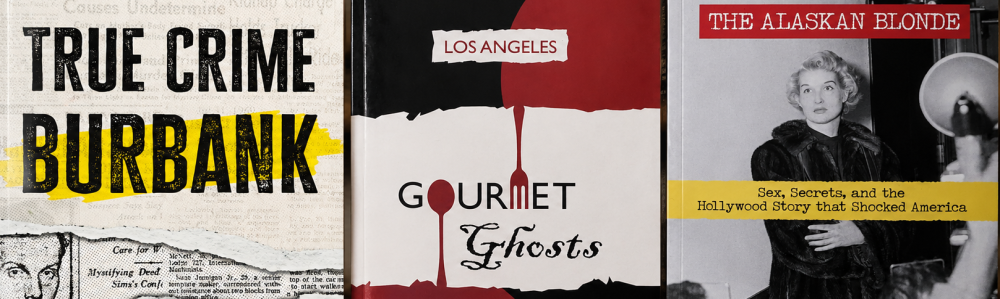
Travel journalist, "Ghost Adventures" guest, true crime book club host and author of the "Gourmet Ghosts" alt guides to the crime, ghosts, history and food of Los Angeles bars, restaurants and hotels, his latest book "The Alaskan Blonde" will be released in 2021, and is a 1950s true crime story of a murder in Alaska that ended with a suicide in Hollywood.
TESSA is the name for the digital photograph collection of the Los Angeles Public Library, and among the many thousands of images are those of the Valley Times, a newspaper that was in print from 1946 to 1970.
One particularly chilling photograph of theirs shows Burbank detective Robert Coveney holding what appears to be some large pieces of rock – only there were suspicions that they were in fact the remains of a burned human heart, lung and bones.
The heart, which had threads of what appeared to be silk attached – perhaps from the clothes its owner had been wearing? – had been found by Lionel Meeker on October 13, 1948 when he was cleaning the incinerator at the rear of his new home, a small white cottage on North Catalina Avenue.
The grim and puzzling discovery was described as “plunging police into a full-scale investigation of a possible mystery murder,” and the items were rushed to the sheriff’s crime laboratory in Los Angeles for analysis.
What had happened? Had someone been killed and their remains burned in an attempt to hide the crime? Police established that a Robert Lincoln Scott had lived there from 1933-1938, but he was since deceased, and before Meeker, two young men had lived there together.
It wasn’t unknown for medical students to play pranks with amputated legs or hands they had purloined from their classes and studies, but this was different. When further “bones” were found in the ashes Meeker, 22, told police he had washed away into the street at the end of a nearby avenue, investigators became more concerned.
Detective Coveney felt there was “no doubt” they were human, but then the laboratory results came through, and Lieutenant Fred V. Wolfe reported that preliminary analysis showed them to be inorganic matter, perhaps plaster of Paris or asphalt.
The story disappeared from newspapers immediately, and perhaps these “human remains” were just old props from a movie designer or make-up specialist, or were thrown into the flames by a frustrated artist.
Avery Truesdale, aged just 19, died by suicide at Los Angeles City Hall on July 15. He jumped from the 26th floor observation deck, which is open to the public, though you have to show ID at security before entering the building.
LAFD medical personnel found him unconscious and not breathing on the steps of the building, and the autopsy listed the COD as blunt trauma. Tributes came in for the young man, who graduated Arcadia High School last year and was known for his talent on their baseball team.
This was seemingly only the third suicide at City Hall since it was built in 1928.
The first was on April 30, 1931, when Robert Pollock Craigie, 36, crawled out of a window on the 19th floor and jumped. He was a visitor to LA from Cairo, Egypt, where he worked at an oil company, and had planned to marry his local sweetheart, Hilda Seagroatt, but the stock market crash had bankrupted him.
“Death came quickly” reported the LA Times, which explained that Craigie had left two formal notes inside his cap on the floor behind him. Hilda was said to be baffled by his actions:
“Why, only a half-hour before he did it, we talked over the telephone and he seemed in the best of spirits. We made an engagement for dinner, and afterwards planned to move my belongings to a new apartment not far from his.”
The second suicide was in December 1934, when Michael Roomanoff, 43, leapt to his death here. There were few other details available, except that it was perhaps a “suicide-of-honor”, as his insurance policy went some – but not all – the way to paying back a large loan from his friend, Ben Stoloff.
A dive into the LA Times archives offered more information however, and a very interesting backstory for Roomanoff emerged. He was known as Gisch Roomanoff back in April 1931, when he was facing a $4,000 grand theft charge after swindling Meyer Levin, a Glendale builder, on an investment “opportunity” – and it appeared Levin was just the first of many victims.
“Financial advisor” Roomanoff had been transported to jail after spending time in the hospital at Redondo Beach, where he had jumped from the pier a week earlier – perhaps also a suicide attempt.
If you or someone you know is experiencing a mental health crisis, help is available 24 hours a day, seven days a week. Call or text 988 to reach the Suicide & Crisis Lifeline. Live support is also available online through its website.
In 1955, the Moulin Rouge was a sensation in Las Vegas, and it wasn’t even on the Strip. It was the first de-segregated casino and hotel in town, and led the way for all the others. But it’s flame burned only briefly, and now – after years of different owners, fires and neglect, but now it’s an empty lot, the sign is at the Neon Boneyard, and all is quiet except for the ghosts of the past. But there is still gambling there for one day, every two years. Why and how? We went to see it all, and I wrote about it for SFGate.
Even though The Alaskan Blonde came out several years ago, every now and then readers get in touch. Sometimes it’s a kind person saying they enjoyed the book, but occasionally it has been friends or extended members of the families involved. Sometimes these missives even contain extra information about the murder case – something that wasn’t known to me at the time.
This week, I was naturally intrigued to hear from Charles Deyoe in Sacramento, California.
He mentioned how I wrote about the items that were found in room 601 of the Drake Hotel in Hollywood, the hotel where Diane stayed for several weeks before going to the Hollywood Plaza Hotel nearby. There she took an overdose of barbiturates on March 9, 1954, a month before the trail was due to begin in Fairbanks.
One of those items was a postcard dated January 22 – but perhaps never sent – to someone called “Sam”. It read:
“Arrived LA today — after an overnight and a big fat steam bath at Paso Robles. After the bath and 9 hours sleep, I began to see life moving around about me. Call me at my sis’ house, Sylvan 0-4664. D.”
I wrote that this phone number seemed to be for La Cañada Flintridge, California, but nothing further about it, as neither the LAPD or FBI followed up on it at the time. It was a mini-mystery though, until now, when Charles (known as Chuck) emailed to tell me that he had found out about SYlvan 0-4665.
He told me that at that time, it was assigned to Martin L. Fisher, who lived at 1125 Wiladonda Drive in La Cañada Flintridge. He added that Fisher lived there until the end of 1959, and that Wiladonda house, which was built in 1952, is still standing in this scenic and well-to-do area (and is worth over $2m today).
Chuck also found a 1950 record of Martin L. Fisher who listed his employment in “Production Control Aviation,” and was married to a woman named Barbara. He attached jpegs of the phone book and census records, so I could see.
The name “Barbara” rang a bell immediately: when Diane had checked into the Drake Hotel, she used the name “Barbara Walker of Seattle.” This tallied with the empty barbiturate prescription bottle later found in her room, which was also made out to Barbara Walker. Diane’s first married name was Walker, so that was a logical choice, but was there a chance she borrowed the name of Martin’s wife?
That was a stretch perhaps in relation to this great piece of historical research, but the more important question was: who exactly was Martin L. Fisher?
In the book, I explained that the FBI file contained a number of letters sent to Diane from what we might generously call “well-wishers.” They come in the guise of a concerned citizen, “old friend,” or simply someone who wanted a dash of drama in their lives.
Such letters are regularly sent to people under suspicion or jailed for scandalous crimes, and Diane had a number of them in her possession when she died.
One dated January 18, 1954 was from a man named Thomas B. Cooper in St. Louis, MO, who called himself “your loyal waiter.” He said he hadn’t heard of her in a long time, but that she should “smile, (as) there’s many things to say and must be said to my and your benefits.” He asked her to write back so he could pass on whatever wisdom he had to offer, and hoped they could “talk face-to-face.”
Frank Del La Reyes wrote from Anchorage, Alaska, on January 27 with “Confidentiality Please” underlined several times at the top. It was largely unreadable, but he was writing about something of “vital importance, and is of course something you should know before you return to Fairbanks. I will tell no one other than you,” he wrote. Under his name at the end of the letter, he wrote “Registered professional engineer.”
One was creepier, like the neatly-written missive dated January 20 from someone named John C. Ivory, who gave his address as the Veteran’s Hospital in Excelsior Springs, MO. Initially supportive and offering friendship, it slowly changes and he calls her darling, then says that he is “alone in this world,” but hopes they could become “acquainted.”
Why Diane kept these letters is hard to say, and we don’t know if she replied to any of them. Maybe in her unhappy state of mind, she grateful for any kind words, even if they were from strangers.
None of them however are from a Martin L. Fisher, so we can really only speculate who he was, and why Diane had written him a postcard; whoever they were, they seemed to have let Diane stay with them. Additionally, Diane was an only child, so the line “Call me at my sis’ house,” did not relate to Barbara Fisher – unless perhaps “sis” was a non-sibling term of affection.
There are many other possibilities too: perhaps the Fishers – or one of them – were friends of the Mansfields, the family Diane and her son Mark had been staying with in LA? Maybe they were a friend of William Columbany, who had followed Diane to LA and seemed to be her constant companion, or friends or acquaintances of her family? Or just a couple that Diane had met in the huge metropolis.
Then of course there’s the question of who “Sam” was – the person she addressed that postcard too. Was it a shortened version of Samantha? There was no one named Sam in my book, and I couldn’t remember coming across that name during my research, so it seems that this contact between Diane and the Fishers will remain a mystery – albeit it less of a one, thanks to Chuck.
Below is a short story I wrote based on a real event that happened at the Hollywood Bowl…
“Death Under the Stars” was one headline, while another read “Death in the Spotlight”. My paper didn’t use anything imaginative, but the report began: “Under the curving shell where the great names perform under the moonlit skies…” Worthy of a Pulitzer, maybe. What did I know? But where the hell was my goddamn photo? I’d thought it was my big break. I got a tip from my (only) contact, jumped in a cab, and arrived at the Hollywood Bowl before anyone else.
At the center of the famous stage was the body of a dead man.
He had short black hair and was wearing a suit with a vest but no jacket, and his shirt sleeves were rolled up to the elbow. Looked like he had been singing to the empty seats, and then just laiddown and gone to sleep. Someone wearing an expensive suit shouted at me, and since there was a cop behind him, I assumed he was a detective. I only had a minute or two to compose the shot, so I stood at the back of the stage and pointed the camera at the rows of wooden benches.
I hesitated, struck for a moment by what I could see through the lens. This was the Hollywood Bowl, after all. I had seen Sinatra here, and lots of classical music too, when I had been trying to impress a girl that I met at Schwab’s. I pressed the button: the shot captured the photographers, the cop and the detective looking down at the body like a curious Greek Chorus.
I knew this was going to make the front page.
More police arrived, and Monty, Bill and the other photographers were hustled away before they had taken any good shots. They didn’t go quietly, as this wasn’t the deal: the press and cops were tight in L.A., especially on a juicy callout like this. It had legs, and could run in the paper for a few days. That usually meant everybody got paid.
Dusty, the grumpy photo editor, raised a bushy eyebrow when I told him what happened. I paced up and down while the film was developed – rookies like me don’t get to touch the developing equipment – then he shouted: “Go get a drink, kid. Good job.”I swaggered to the bar like I was the West Coast Weegee, and several beers later someone brought in a copy of that evening’s paper. Flicking through page after page in disbelief and then anger, I found nothing but a report on the victim. Where the hell was my goddamn photo?
Bill and Monty looked at me sympathetically. “Don’t take it to heart, kid. It happens,” said Bill, waving to the bartender for another round. “Yeah. I only got page 12; he was page 11. You woulda thought it was a given: a dead body at the Bowl? Front page for sure,” added Monty.
The red telephone rang. A clever editor had it installed here back in the day, as he knew freelancers were here, like dogs hanging around a campfire. Not on salary, we were paid by the shot – the published shot. The duty news editor told me to come to the office right away, and I sobered up real quick as I walked the couple of blocks to their huge building. “What’s your name?” said the mustachioed news editor, who I had never met, as he pulled out a check book. “They just didn’t have the space to run it,” he said, bored. “It happens.”
“Yeah, I’ve heard that,” I mumbled. But mustache was already on the telephone.
“Never seen that before,” the secretary whispered to me as I stumbled out of the office.
I went back to the bar, because what else was I supposed to do? I didn’t mention the check, because $200 was more money than I’d seen in a long time. My rent was due, and the electricity, and the gas, and the car. But I was confused. My photo had been spiked, despite the other papers running ones that can’t have been as good. What the hell?
Bill began reading the report out loud. The dead man’s name was Otis Leery; he was 39, and police had determined it was suicide.
“You woulda though he was an actor, going out like that,” said Monty.
“Close enough,” said Bill. “He was an interior decorator. And he wasn’t married.”
He wolf-whistled, and I looked around for a blonde, because Bill wasn’t subtle about that kind of thing. But the bar was empty. Monty rolled his eyes.
“One more for Monty,” I shouted to the bartender, putting some coins down on the table. “You can get your own,” I hissed at Bill, snatching his newspaper from him as I went.
“What? It was a joke!” he protested.
I didn’t laugh. $200 in my wallet, but I wasn’t in the mood. I walked a few blocks to clear my head, and ended up at one of my favorite places: Angels Flight. On the first day I arrived in LA, and then every time I came downtown, I took a ride on the silly orange train. Always cheered me up. A minute or so of creaking wood, clanging bells and whining cables later, I realized I still had Bill’s newspaper clenched in my fist. I was about to throw it in the trash when I saw his photo they published.
It showed Leery’s body in a completely different position.
In my photograph, Leery’s arms were bent at the elbow, resting on his chest like he had been playing Tarzan, or was ready for his coffin. But in Bill’s, his arms were splayed out beside him. But there was something else. In Bill’s picture, there was a gun right beside Leery’s head. Suicide, the police said. But I hadn’t seen any gun, and that meant that the crime scene must have been tampered with. Maybe Leery had been murdered, but it was made to look like a suicide. Was that why they didn’t run my photo?
*****
I went back to the office, but Dusty wasn’t there. “Vacation. Catalina Island, then Mexico. Lucky bastard,” growled his grizzled replacement. “Must be nice,” I replied, as I scanned the room to see where Dusty had put my photos. Usually they would be laid out in sequence, but not this time. Then I spotted them on a desk that was just too close by, so I made small talk and got in the way. An “accidental” spill of some coffee, and I was told to get lost. Which I did, with the photographs under my arm, wrapped inside Bill’s wrinkly newspaper.
On the trolley back to my Hollywood hovel, I compared them together. Should I go to the cops? No. That detective surely saw my face. And that cop. Mustache editor? No. They’d spiked the photo and still paid me. It would look like sour grapes. And what if I was wrong? It would kill my reputation – such as it wasn’t. And some might say that $200 was a payoff. I’m new in town, and the L.A. papers are vicious rivals. The freelancers too. Monty and Bill have been kind to me, but they weren’t happy I got the jump on them at the Bowl.
I sat down and read the report on Leery again. The last man to see him alive was a friend of his named Harry Ford, who told police that Leery had seemed depressed, but insisted nothing was wrong. Leery’s sister, Doreena, had no explanation for what had happened either. Nevertheless, the scandal-hungry reporter speculated: Leery had won big on the Sweepstakes a few years ago, but had “come up short this year.” The slight was obvious: had he spent it all, or did he have a gambling problem? The suicide story might make sense if that was true.
But my photo didn’t tell that story.
I reached into the fridge for a beer, and banged my head on the door when the telephone rang. It was late, but tips could come at all hours and I was glad to hear Bill’s voice – at least for a couple of seconds. “The police have been asking about you,” he said gruffly, and hung up. I was chilled, and not just from the beer. Then I remembered I had ragged on Bill in the bar earlier. Maybe he was playing a prank on me. Maybe.
I looked again at the two photos. If my photo did prove that Leery had been murdered, or even that the body had been moved, it was evidence. And I had kind of stolen it.
Harry Ford’s eastside address had been in the report, and so I drove to his house, even though it was late. His mailbox had a few letters in it, including one from the very same Sweepstakes, so I took them to the door. He worked at Paramount, and said he and Leery met at Santa Anita Park, but were just “track friends.”
He seemed sorry that Leery was dead, and said that Leery’s luck had been “up and down, like ‘tis for all us guys,” though he “’ad bin on a bit of a bad streak lately. Shame. Can I help yous with anythin’ else?”
My final roll of the dice was seeking out Doreena, Leery’s sister, but that would have to wait until morning. It was going to be a tough knock. I’m no reporter, no whizz with the ladies either, and she had just lost her brother. With nothing but coffee for breakfast, I arrived at her house in Hancock Park as early as I dared and introduced myself as Bill Monty from the Times, which was only half a lie, and tried to fend off a small dog that wouldn’t stop yapping. Judging by the noise there were at least two children in one of the rooms as well.
For a moment she didn’t seem convinced by my story about an obituary, but when I tried to distract her by saying she had a beautiful home, tears came to her eyes. It happened so quickly I thought it was a trick of the light. “Otis helped me with all of this,” she said, gesturing around her. “Please take your shoes off, and come in. Would you like some coffee?”
A maid brought in the coffee, and Doreena talked about her late brother. They had been close, especially in recent months when – she flushed slightly – she and her husband had been having “difficulties.” I had noticed there were no large size shoes, or men’s coasts, in the hallway.
I glanced at the pictures on the mantel. City Hall was in a couple of them, and it was clear her husband was someone “important.”
Back in the day Leery had been a promising actor, Doreena said with a smile. He had married an actress, but she left him after just six months – for another actor.
“You know what they’re like,” she said to me, rolling her eyes. I smiled as if I did.
Since the newspaper report had mentioned the Sweepstakes, I felt I could bring it up. She said Leery had been generous, and bought the dog for his niece and nephew – a bark nearby seemed to confirm this, and we laughed.
“But I think he liked to gamble, sometimes. What man doesn’t? But he would never have…” she paused, “done that. What they said in the paper.”
If I was going to say something, this was the moment. But too late.
“And those photographs! There for anybody to stare at like some cheap gawker!”
I glanced at the doorway, and the children were standing there, the dog at their feet. They looked like they had just found out Santa Claus wasn’t real.
“Go and play, please. Mommy’s just a little upset. This nice man is a friend of Uncle Otis.”
“Is Uncle Otis coming to visit?” the younger one asked. I was grateful the dog started yapping.
“The last time I saw him, I asked if he owed money to, well, people who weren’t exactly Main Street bankers,” Doreena said, swiping any out-of-place mascara off her cheeks. “He laughed, and told me he was about to get a new job. At one of the studios, I think.”
I thought of Harry Ford and his job at Paramount. Or maybe it was another place in Hollywood?
Instead of driving home, I went back to the Hollywood Bowl.
*****
As I thought, it was easy for anyone to get inside. Hop over a fence, or get your hands and knees dirty and scramble up the hillside.
“The box office aint open until May. Come back then,” said an elderly black man with a bunch of keys on his belt that were as big as a baseball.
“I’m a reporter from the Times,” I lied again. “I was told you know all about the secret tunnel under Hollywood Boulevard.” It was one of the wild goose chases I had been sent on when I first arrived in town, but his face was like Buster Keaton. Then he laughed.
“Porter Johnson,” he said, offering his hand, “but everyone calls me “Keys.”
He took me to a small hut, offered me coffee from his thermos, and told me several stories. “I seen raccoons on the stage. A fox too, one night. Came right on stage, dandy as you please, sat behind the pianist. The tuxedo though the applause was for him!”
He paused for a moment, and on cue, a coyote howled somewhere far away. At least I hoped it was far away. “Bad business, that poor man who kilt himself,” said Keys. “I’ve chased plenty of kids out of here, some adults up to no good too. But nothing like that.”
A three-legged tortoise could have outrun Keys, and he wasn’t on duty that night anyhow, so he definitely wasn’t involved in the murder. And I was calling it a murder now, at least in my head.
After talking to Keys, I called Ford’s apartment. The landlord told me he had skipped out on his rent. Now I’d sort of put it together, and I had no options left.
I had to become a traitor.
In an office off of the deserted newsroom, I told the Examiner’s managing editor what I thought had happened. He remained stoic at first, but when he started nodding and shifting in his chair, I knew he was interested. That this was going to be my first front page.
“It wouldn’t have been hard to get Leery to the Bowl on the pretext of a possible job,” I continued. “And for an ex-actor, it would have been a thrill stepping out on that stage.” I knew that was true, because I had felt that when I was there. “And Ford and Leery both played the Sweepstakes,” I continued.
Used to fund the building of hospitals, your chances of winning were about as good as finding me awake before 8am, and it was a well-known secret that it was a front for the mob. The managing editor nodded. “Collect the cash from saps who never expect to win anyway, and then fix the draw so that someone like Leery or Ford gets lucky. Not that they win the main prize. That’s too obvious. But maybe a few grand, here and there? The lucky “winners” already owe you plenty of course, so the cash just comes straight back.”
“Or else,” I added.
“Or else. A simple cake and eat it scam, unless someone spends all the money on losing horses.”
Or a yapping dog that loved kids. “I don’t know who met Leery at the Bowl, or what gang he was from,” I said. “Maybe it was Ford, but I doubt it. That’s for the cops to work out anyhow, right?”
The managing editor stroked his beard and told me that the cops and the mob were at each other’s throats, more than anyone knew, and that the cops were close to blowing open the Sweepstakes scam. He had been promised him the scoop when it happened.
“They found Leery’s jacket later,” he added, “and it had a Sweepstakes ticket in the pocket. They were keeping that information back.”
“Maybe Leery wanted to “win” the Sweepstakes again, and threatened them when they said no.
So they decided to make an example of him,” I said. “And what better place than on the stage at the Hollywood Bowl? That would make all the papers, and send a hell of a message. But I guess the cops couldn’t allow that, could they?”
“No.” said the managing editor. “So they stick a gun beside the guy, and it’s suicide. Goes from front page to page 11. It happens all the time. Poor sap.”
I thought of Doreena, and her children, and even that damn dog. Otis Leery wasn’t a poor sap.
“Where’s the picture?” he said, holding out his hand. He looked at it for several moments.
“See? He was actually raising his hands in surrender. Or pleading for mercy,” I said.
I left the newsroom with a five-year contract – at the Examiner’s New York office. Freelance or not, giving a story to a rival was always a betrayal, and I couldn’t work in L.A. anymore. I went back to my hovel, filled a couple of suitcases, and sold my car at a garage near Los Angeles Airport. I waited it out in the echoingly quiet terminal, and just as they were calling my midnight flight to Idlewild I heard the thump of a bundle of newspapers hitting the kiosk floor.
I asked the gate attendant to wait, and fumbled for 10 cents.
Today I am posting the first in a new series of historical stories about murder, suicide and mayhem – and they will all be based around the Los Angeles River.
Many of you only know it as a concrete channel that has played backdrop to movies and TV, or shows up on the news when people or dogs need to be rescued from raging rain waters.
But the LA River, and the bridges that span it, has a long history. It was a vital resource for the indigenous people onward, and temporary bridges were the order of the day. They were often swept away when the river flooded, and even when the sun was out it was common for adults and children to end up in the murky waters, either by accident, murder or suicide.
So, I have researched some of the wildest, strangest and saddest stories associated with the LA River, which means for a start that the beautiful but infamous Colorado Street Bridge – the so-called “suicide bridge” in Pasadena – is here.
It opened in December 1913, and close to 100 people had their last earthly moments here in the more than two decades before the more notorious suicide hotspot, the Golden Gate Bridge in San Francisco, even opened: it’s arguably the equivalent of the Cecil Hotel in downtown LA, which is another location where many souls have passed to another realm….
On May 4, 1929, Leland Wesley Abbott, 33, was arrested in connection with the murder of a young woman whose torso had been found on April 4 in the quick sands of the LA River near Lynwood Gardens. She was missing her arms, legs and head, and “was about to become a mother,” noted the Los Angeles Times.
The torso was found after heavy rains and not more than 24 hours old, but identification was still uncertain. Her age was estimated to be 18-25, and her appearance roughly matched descriptions of Abbott’s wife – who was 22. The coroner also noted that the limbs and the head had been severed with some surgical skill.
Newspaper reports said that Abbot’s estranged wife had last been seen the day before the torso was found, and that a couple of days earlier to that Abbott had confided in a work colleague, Ray Martin, that she was living with a man in Lynwood, and that he intended to “get even” with her. He had added that there was “plenty of quicksand” in the LA River near where she lived.
The Sheriff’s Homicide Squad knew Abbott had served time for gun smuggling, and had married in Cincinnati soon after his release, but they were uncertain of his wife’s first or maiden name, let alone her whereabouts.
More promisingly, Abbott was known for carrying a surgical knife with a 5-inch blade, but further clues – a green slipper (size six, left foot) and some blood-stained towels found on the riverbed – were discarded as having no bearing on the case.
Two other men of interest – a physician who had left LA with his 19-year-old girlfriend, but neither of them had been heard from since – and another physician who was seen near the murder site, and had previous arrests. Both leads led nowhere either, nor did viewings by people who had recently-missing relatives.
Abbott was found on May 4 at a mountain camp on a government reserve, some 33 miles north of Mt. Wilson, where he said he’d gone for a road-building job. He didn’t have his knife with him though – which he said he carried because his stepfather was a surgeon – though investigators found a handful of weapons in Abbott’s trunk, which he said he had recently washed with gasoline. The trunk had some strange stains on it, too.
Then there was the anonymous call from a woman who had seen two men lift a large package out of a car alongside the LA River– and that there was a woman in the driving seat. She thought it was unusual, because at the time it was raining heavily. But she never called back.
Ultimately police simply didn’t have enough evidence to hold Abbott, and released him after a few days. Bizarrely, on May 12 Abbott returned to the police station with his knife, which he said he’d found. Presumably it passed forensic tests, because Abbott then returned to his road-building job, and the story disappeared from the newspaper archives….
This photo is from Calisphere, and was originally from the Valley Times newspaper, which is part of the huge digitized photo collection of the LA Public Library. It shows singer Phyllis Moriarty and was dated January 4, 1950. Moriarty, a Burbank singer, “flew to Alaska today to collect a $10 bet…She had to pose for a picture at Hollywood and Vine – in fur parka and mukluks – to win it. She was in Alaska last winter…a discussion among a group of her Alaskan friends over clothes styles of the frozen north led to the wager. She returned to her home…bundled up and stood on the corner and while an amused crowd watched, had her picture taken. She took the picture with her when she left Lockheed Air Terminal for Fairbanks via United Airlines yesterday afternoon.”
It’s a great story to start with, but of course I wondered: she was a singer who went to Fairbanks – did she ever sing with, or perform on the same bill, as Johnny Warren? Lo and behold…. nearly two years later in October 1951, the Fairbanks Daily News-Miner reported